:quality(80) "header-bed-to-bed")
:quality(80) "medical-cost-02")
Key points to remember:
Air ambulance costs are always customized; every mission is priced individually based on the patient's medical needs, flight distance, aircraft type, and level of clinical care required.
Every MTI 24/7 quote is fully transparent and itemized, covering the aircraft, medical crew, equipment, ground transfers, and all coordination from first call to bedside arrival.
Not every patient needs a full air ambulance; clinically stable patients may be better served by a medical escort on a commercial flight, offering the same professional care at a lower cost.
Intro: When a medical emergency strikes, whether close to home or on the other side of the world, every decision carries weight, including how to get a patient safely to the right hospital. Air ambulance transport makes it possible to move critically ill or injured patients across cities, countries, and continents without interrupting their medical care. Understanding the costs involved should never add to that pressure. MTI 24/7 coordinates medical flights worldwide, 24 hours a day, with full pricing transparency, so patients, families, hospitals, and insurers always have a clear, expert answer when it matters most.
What is an air ambulance and how does it work?
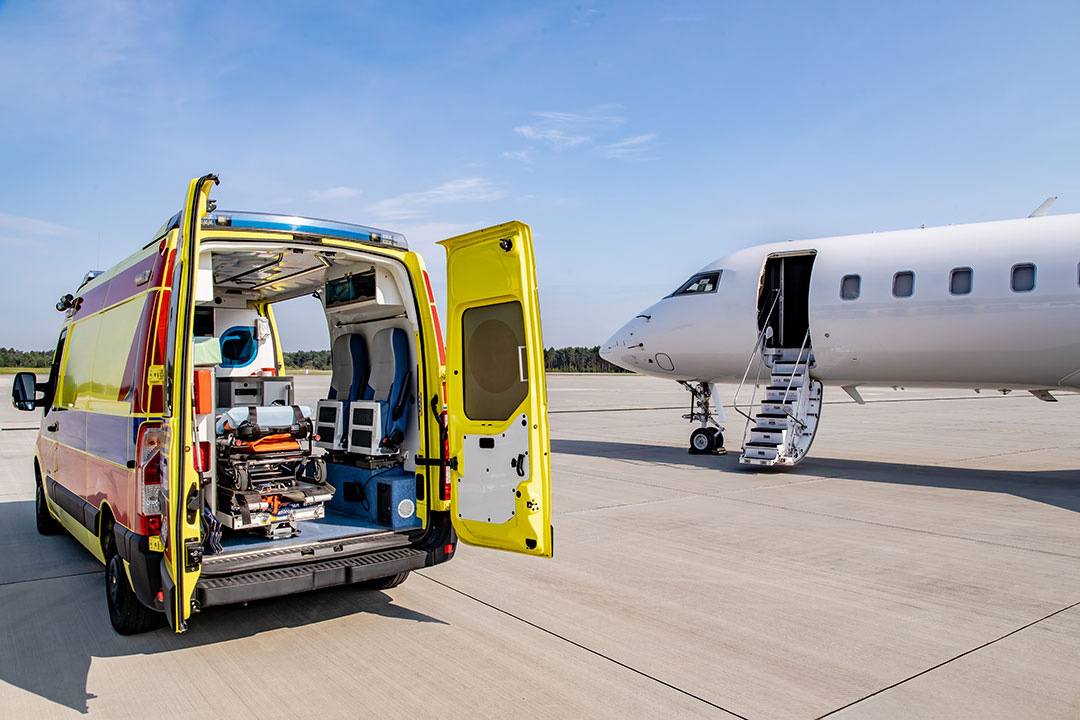
An air ambulance is a purpose-configured aircraft, fixed-wing or rotary-wing, in which the cabin functions as an airborne clinical environment. Unlike a standard transport flight, it carries a dedicated medical team and is fitted with life-support systems, monitoring equipment, and medication capable of sustaining intensive care throughout the entire journey.
The defining feature of an air ambulance is continuity of care: medical treatment does not pause at departure and resume at arrival; it continues, uninterrupted, from the patient's bedside to the receiving hospital. This makes it a fundamentally different service from a charter flight, a commercial airline, or even a medical escort on a scheduled service.
How much does an air ambulance cost? Every flight is priced individually
There is no universal price for an air ambulance flight. At MTI 24/7, every quote is fully customized to the patient's specific medical situation, location, destination, and logistical requirements.
Air ambulance costs vary depending on the scope of the mission. A short domestic flight for a stable patient involves a very different level of resource and planning than a long-haul international medical transport for someone requiring intensive care in the air. Attempting to quote a flat rate would be misleading, and in medical transport, accuracy is everything.
What patients, families, and insurers can expect is a transparent, itemized quote that reflects the exact services required, nothing more, nothing less. MTI 24/7 provides these quotes rapidly, at any hour, with full coordination from the first call through to bedside arrival at the destination hospital.
What factors affect the cost of an air ambulance flight?
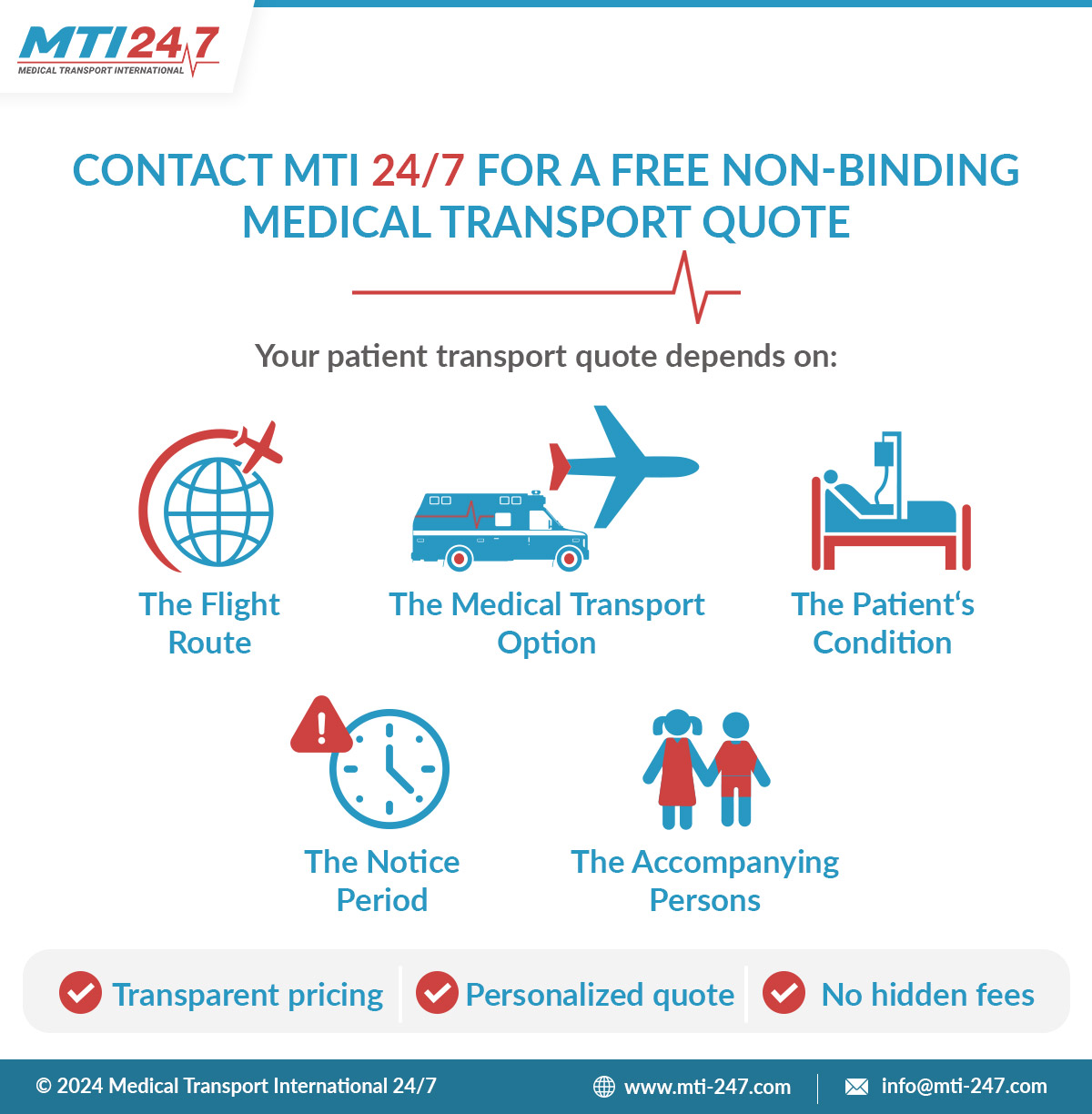
Several variables come together to determine the final cost of a medical flight. These factors do not simply add to the price; they define the configuration of the mission, ensuring every element is precisely matched to what the patient actually needs.
Flight distance and routing play a central role. A continental flight within Europe or North America involves different aircraft, fuel requirements, and crew logistics than a transcontinental mission from Southeast Asia to Western Europe. Longer routes also bring additional considerations around crew rest regulations and permitted overflight corridors.
Aircraft type is always matched to the patient's clinical condition and the distance involved. A turboprop may serve shorter regional transports efficiently, while a long-range jet with full ICU configuration is required for intercontinental flights or patients needing advanced life support throughout. The aircraft category is a direct reflection of what the patient needs, not an arbitrary upgrade.
Medical crew composition is determined entirely by the patient's clinical profile. Some missions require a flight nurse and paramedic. Others require a specialist physician, anesthesiologist, or neonatologist, particularly for complex ICU cases, cardiac events, or neonatal transport. The team is always assembled around the patient's documented medical needs.
Medical equipment on board varies accordingly. Ventilators, defibrillators, infusion pumps, transport incubators, and oxygen systems all have operational and weight implications that are factored into mission planning from the outset.
Ground coordination at both ends, including ambulance transfers, hospital-to-hospital liaison, and any formalities, forms an integral part of the overall mission design. A true bed-to-bed medical transport requires seamless coordination, and that level of oversight is built into every MTI 24/7 operation.
Mission scheduling also shapes how a flight is structured. A planned medical transfer allows optimal aircraft positioning and crew preparation. An urgent activation requires prompt mobilization, which influences how the mission is resourced and organized.
What does an air ambulance invoice include?
A properly structured air ambulance invoice is comprehensive and transparent. When you receive a quote from MTI 24/7, the following elements are covered within a single, clearly itemized cost:
Ground ambulance transfers at origin and destination.
Medical crew: all clinical personnel required for safe, continuous in-flight care.
Aircraft charter: the aircraft appropriate to the mission, fully configured for medical transport.
Medical equipment and consumables: including life-support devices, medications, and oxygen supply.
Full mission coordination: 24/7 case management from first contact through to handover at the receiving hospital.
Airport handling and overflight fees: the operational costs associated with international routing and airspace permissions.
Documentation support: including medical clearances, border health formalities, and all necessary invoicing and bank details to support insurance reimbursement processes.
There are no hidden line items. Clarity and transparency are standard features of every MTI 24/7 mission.
Air ambulance vs. medical escort: Which medical transport do you need?
Not every patient requires a dedicated air ambulance, and selecting the right medical transport option depends entirely on a thorough clinical and logistical assessment.
Dedicated air ambulance is the appropriate choice when a patient is medically unstable, requires active monitoring or intervention during the flight, or when the journey involves a significant international distance. It offers complete control over timing, routing, cabin configuration, and the clinical environment throughout.
Medical escort on a commercial flight is a strong alternative for patients who are clinically stable but still require a trained medical professional alongside them during travel. A flight nurse or physician accompanies the patient on a scheduled airline, managing their needs throughout the journey. This option is typically more cost-effective and works well for post-discharge situations where the patient no longer requires intensive care.
Ground ambulance remains appropriate for shorter distances or where air transport is not medically indicated. For international or long-distance missions, however, road transport is rarely practical or safe for the patient.
MTI 24/7 evaluates each case on its clinical and logistical merits and recommends the most appropriate transport modality, always prioritizing patient welfare over cost or convenience.

Does health insurance or travel insurance cover air ambulance costs?
The honest answer is: sometimes yes, sometimes no, and the specific terms of a policy matter enormously.
Many private health insurance plans include some level of medical evacuation or repatriation coverage, but the scope varies widely. A policy may cover air ambulance transport in principle, yet still exclude certain aircraft types, destination countries, or clinical scenarios. Pre-authorization requirements, in-network provider clauses, and policy payout caps can all affect what is ultimately reimbursed.
Travel insurance frequently lists emergency medical transport as a benefit, but coverage limits may not fully meet the cost of a long-haul international medical flight, particularly one requiring ICU-level care throughout.
Corporate and expatriate health plans tend to offer more robust patient transportation benefits, though the conditions of activation and the definition of "medically necessary" can still create coverage gaps in practice.
Self-funded patients do arrange air ambulance transport directly, and MTI 24/7 supports them with clear, detailed pricing and full mission coordination.
MTI 24/7 does not liaise directly with insurance providers. However, we provide patients, families, and case managers with all the necessary invoicing documentation required to support reimbursement claims or direct payment arrangements with their insurer, ensuring the administrative dimension of the mission is managed as smoothly as the clinical one.
Request an accurate air ambulance cost quote
MTI 24/7 is available around the clock to provide no-obligation quotes tailored precisely to your case. Our team manages the entire mission from the first call to bedside arrival, so that everyone involved can focus entirely on what matters most: the patient's safe and comfortable transfer to the right hospital. Contact MTI 24/7 for a customized air ambulance cost assessment.