:quality(80) "header-bed-to-bed")
:quality(80) "An old bedridden patient")
There is a moment every family remembers: the moment they realize their loved one can no longer get out of bed, and yet, somehow, must still make a journey. A hospital across the country. A home across the world. A specialist on another continent. The fear is real: Will they be safe? Will they suffer? Who will watch over them at 35,000 feet? These questions deserve clear, honest answers, and a team that has handled them thousands of times. MTI 24/7 coordinates safe, dignified, bed-to-bed transport for bedridden patients worldwide, around the clock.
What you need to remember about bedridden patient transport:
Every bedridden patient deserves a tailored transport plan, built around their clinical condition, the distance to cover, and the level of medical supervision required on board.
Air ambulances and commercial airline stretchers offer two very different but complementary solutions, ranging from full ICU-level care in flight to comfortable long-distance travel for stable patients.
MTI 24/7 coordinates the entire journey bed-to-bed, handling medical teams, equipment, documentation, and hospitals so families can focus on their loved one.
Who are bedridden patients? Common profiles and real-life examples
A bedridden patient is someone whose medical condition prevents them from sitting upright, standing, or moving independently. They depend on others for repositioning, hygiene, feeding, and clinical monitoring, and any movement outside their bed must be carefully planned.
Some of the most common profiles we transport include:
A burn patient with extensive dressings, unable to tolerate sitting positions for long hours.
A patient in a prolonged coma after cardiac arrest, fully ventilated, needing transportation to a hospital near family.
A grandmother in advanced palliative care, wishing to spend her final weeks at home rather than in a foreign hospital.
A young motorcyclist with a spinal cord injury, immobilized in a neck brace, requiring flat transfer between trauma centers.
An elderly woman with severe dementia and advanced frailty, who panics when moved and requires gentle, sedated transport.
A post-operative cardiac patient discharged abroad after emergency surgery, cleared to travel only on a stretcher with oxygen.
A 68-year-old man recovering from a major stroke, unable to move his left side, fed through a nasogastric tube, needing to return home to his family abroad.
Every story is different. Every transfer is built around the person, not the protocol.
How are bedridden patients transported safely?
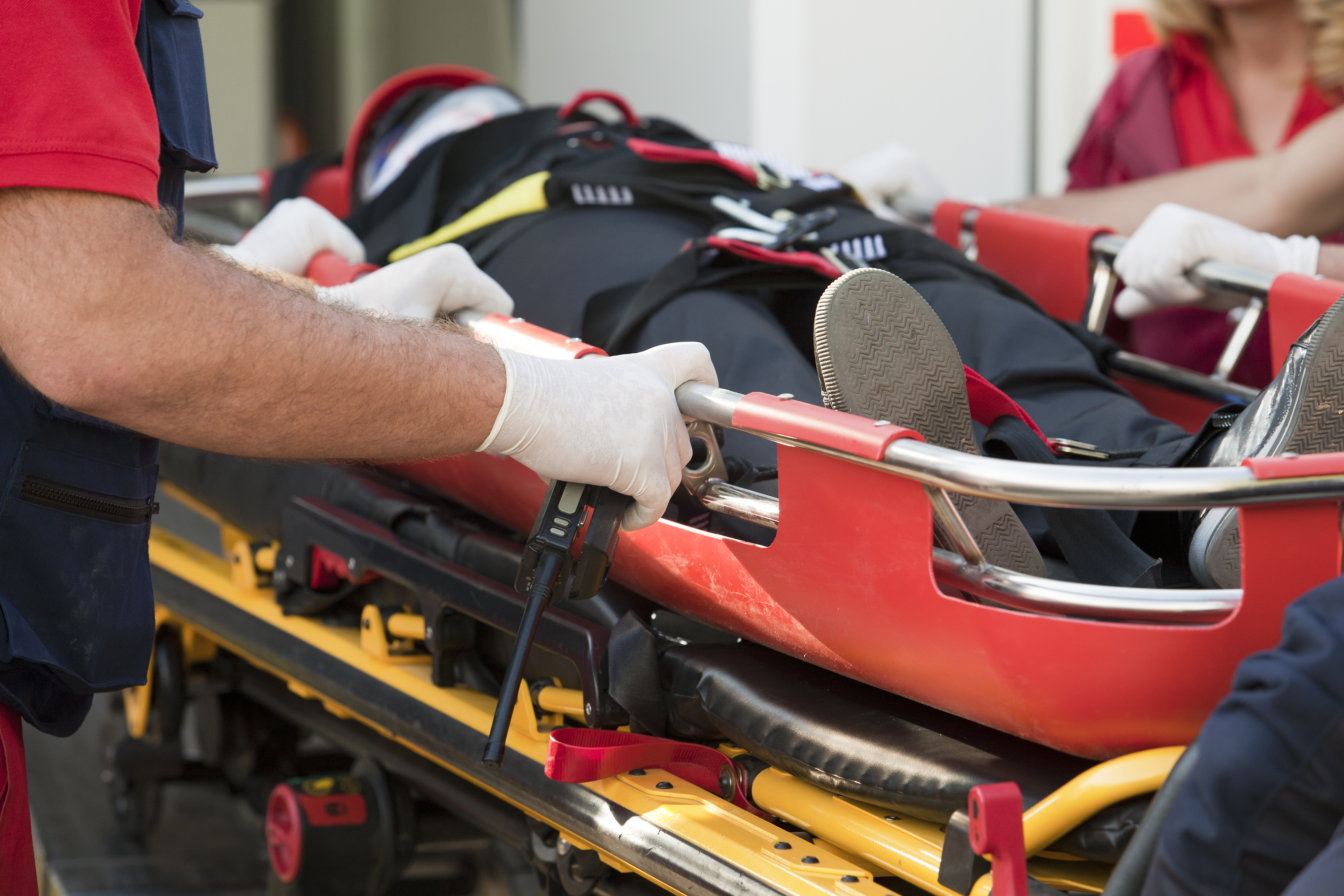
Safe bedridden patient transportation depends on three things: a thorough medical assessment, the right transport mode, and a trained team that knows how to move a fragile body without causing harm.
The main transport solutions include:
Ground ambulance for local and regional transfers.
Air ambulance for ICU-level or urgent international missions.
Commercial airline stretcher service for stable long-distance travel.
How the stretcher is embarked, secured, and disembarked
Moving a bedridden patient is a choreography of precision. Each step is rehearsed and supervised by the medical team.
Patient stabilization in the original bed: vital signs are checked, lines and tubes secured, pain controlled, and the patient is informed of every step.
Transfer onto a stretcher or vacuum mattress: using a slide board or lifting sheet, several team members move the patient in one coordinated motion to protect the spine and joints.
Securing on the stretcher: safety straps are placed across the chest, hips, and legs without restricting breathing. A vacuum mattress molds around the body for full immobilization when needed.
Loading into the ambulance: the stretcher is locked into rails inside the ambulance, ensuring zero movement during transit.
Airport or aircraft embarkation: for flights, the patient is lifted into the aircraft via a high-loader, ambulift, or specialized stretcher ramp, then secured to certified aircraft rails or stretcher frames installed over passenger seats.
In-flight monitoring: vitals, oxygen, infusions, and comfort are continuously checked.
Disembarkation: the reverse procedure is performed on landing, with a waiting ambulance positioned planeside whenever possible.
Final transfer to the destination bed: at the receiving hospital or home, the patient is gently transferred onto the new bed, and a full medical handover is given.
This is what true bed-to-bed transport means in practice.
When Is an Air Ambulance Needed for Bedridden Patients?
An air ambulance is a private aircraft, most often a medically configured jet, transformed into a flying intensive care unit.
Inside, you will find a hospital-grade stretcher locked to the floor, a ventilator mounted on a bridge above the patient, infusion pumps, a multi-parameter monitor, oxygen cylinders integrated into the aircraft, suction units, a defibrillator, and a sealed medication cabinet.
The crew includes pilots trained for medical missions and a dedicated medical team, typically an intensive care doctor and a flight nurse, who care for one single patient throughout the journey.
Unlike commercial flights, an air ambulance flies on the patient’s schedule, lands at airports closest to hospitals, and allows continuous critical care without compromise.
Real situations where an air ambulance becomes essential:
A ventilated patient in a coma needs repatriation home for long-term care closer to family.
A child in a remote region develops sepsis after surgery and must be flown to a specialized pediatric ICU.
An executive has a serious cardiac event abroad and the local hospital lacks the cardiology unit required for safe stabilization.
A tourist suffers a hemorrhagic stroke in Southeast Asia and needs urgent transfer to a neurosurgery center in Europe, ventilated and sedated.
A trauma patient with multiple fractures and internal bleeding must be moved between trauma centers across borders, requiring continuous monitoring and blood products in flight.
A patient with a significantly higher body weight requires transfer with a reinforced stretcher, a larger medical team, and a cabin spacious enough for safe handling and continuous monitoring.
In each case, the air ambulance is selected because time, clinical instability, or equipment dependence makes any other option unsafe.
Commercial airline stretcher services for long-distance bedridden transfers
A commercial airline stretcher is a certified medical stretcher installed by the airline over a row of economy seats, usually six to nine, enclosed by a privacy curtain.
The patient lies flat for the entire flight, while a medical escort travels in the adjacent seat with portable oxygen, monitors, medications, and emergency equipment approved for cabin use.
Airline approval requires a MEDIF form signed by a physician, and the booking must be coordinated days in advance with the airline’s medical department.
Real situations where a commercial stretcher is the right choice:
A retired tourist stranded abroad after a hip fracture; the patient is stable, healing well, but cannot sit.
A cancer patient returning home after treatment abroad, stable on oral medication but too weak to sit for a long-haul flight.
An elderly patient with advanced Parkinson’s unable to remain seated for more than 30 minutes, needing to attend a family event overseas.
A post-stroke patient cleared by neurology, fully conscious, no longer requiring intensive care, traveling internationally to continue rehabilitation near family.
This option works beautifully when the patient is medically stable, predictable, and not dependent on intensive care equipment.
Essential medical equipment used during bedridden patient transport
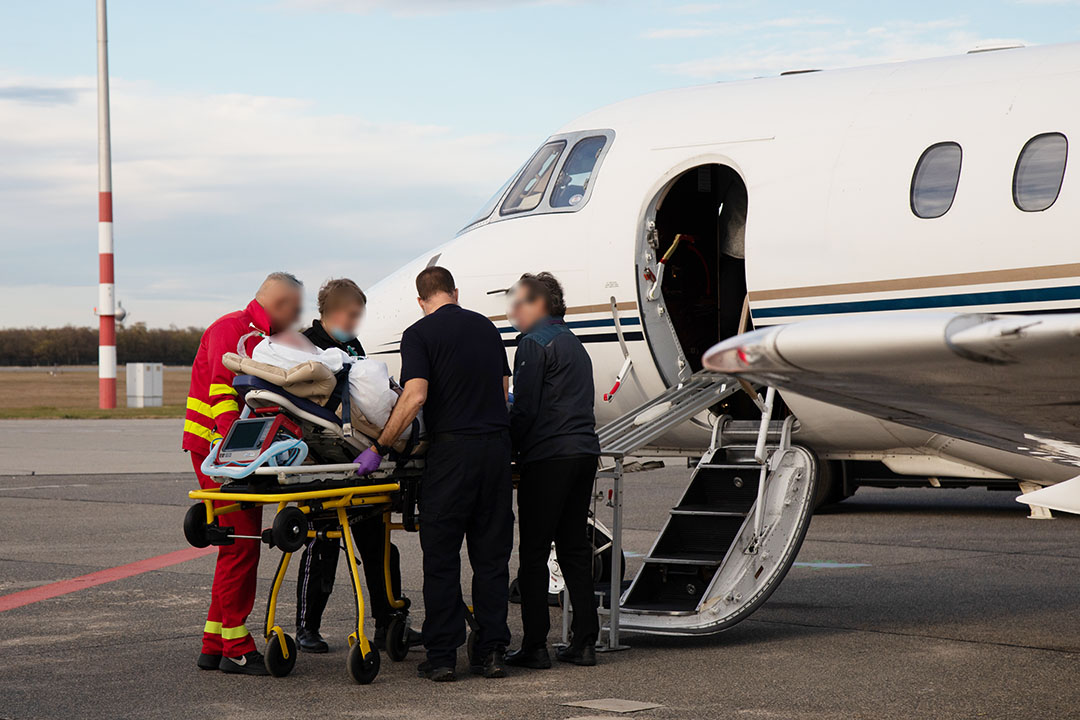
Every piece of medical equipment carried on board is selected after a careful review of the patient’s diagnosis, vital signs, and the route ahead, because the right device, at the right moment, can be the difference between a smooth transfer and a critical event at altitude.
Defibrillator with pacing function: ready for cardiac emergencies.
Suction unit: clears airway secretions in patients with weak cough reflex.
Infusion pumps: deliver precise, continuous doses of sedatives, cardiac drugs, or nutrition.
Wound care and catheter kits: for ongoing dressing changes and urinary care on long missions.
Emergency medication kit: covering cardiac arrest, seizures, pain, sedation, and allergic reactions.
Multi-parameter monitor: tracks heart rate, blood pressure, ECG, oxygen saturation, and end-tidal CO₂ in real time.
Portable ventilator: breathes for patients who cannot breathe on their own, with settings adjusted to flight conditions.
Stretcher or vacuum mattress: keeps the spine aligned and prevents pressure injuries during transfers and turbulence.
Medical oxygen: supports respiratory function, especially important at altitude where cabin pressure reduces blood oxygen levels.
Most of this equipment cannot be brought on board a regular commercial flight, which is precisely why an air ambulance, with its certified medical configuration, becomes the only viable option for critically ill bedridden patients.
Domestic vs international bedridden patient transportation
MTI 24/7 organizes both domestic and international bedridden transfers, adapting each mission to the patient’s clinical picture and the country’s regulations.
Domestic transfers typically include:
Hospital-to-hospital ground or air ambulance transport between regional facilities and specialized centers.
Long internal routes by air ambulance or commercial flight with medical escort, when distances are too great for road transport.
Home-to-hospital and hospital-to-home transfers for patients beginning treatment or returning to recover in their own environment.
International transfers typically include:
Cross-border air ambulance missions: for example, a ventilated patient flown from North Africa to a specialized hospital in Europe.
Commercial airline stretcher transfers: such as a stable post-stroke patient returning from Asia to North America to continue rehabilitation near family.
How to prepare a bedridden patient for medical travel?
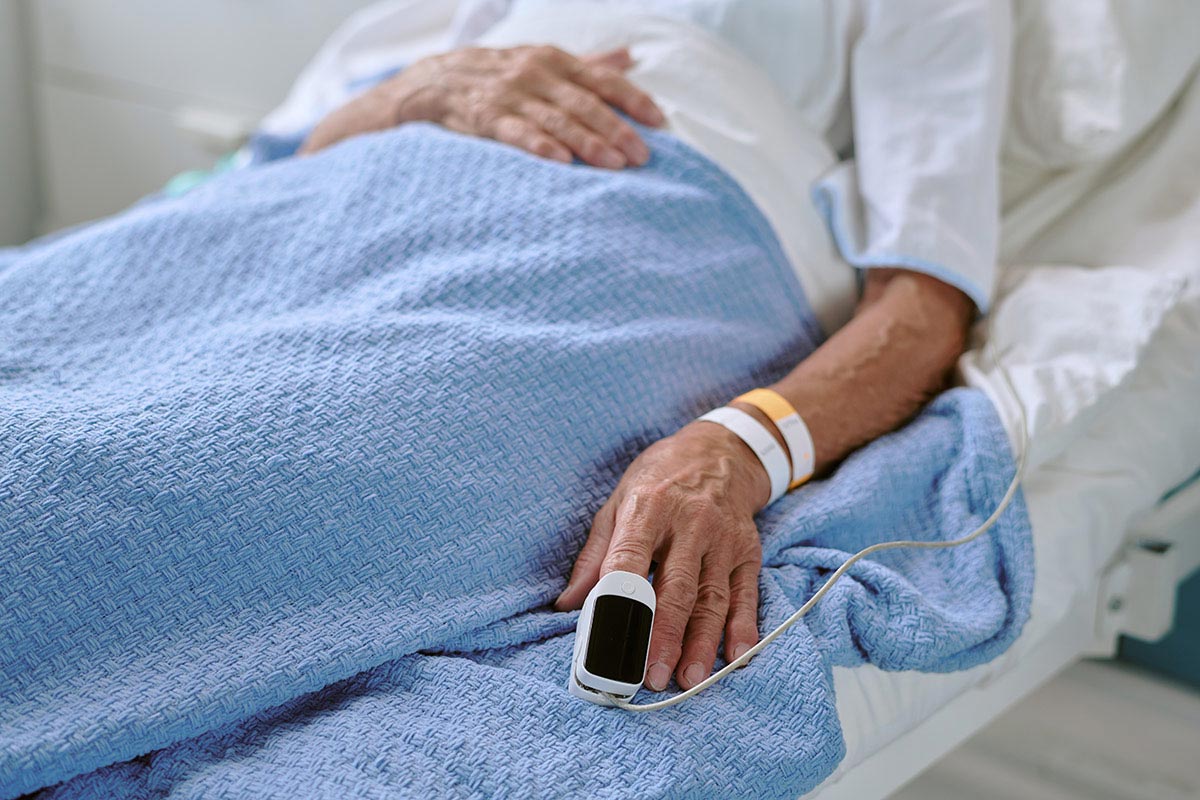
Preparing a bedridden patient for a journey is a structured process where every step protects the next, and every detail is anticipated long before the wheels of the ambulance start moving.
Detailed medical assessment. A physician reviews diagnosis, vital signs, medications, recent imaging, and fitness-to-fly.
Selecting the right transport mode. Stability, distance, urgency, and budget guide the choice between ground, air ambulance, or commercial stretcher.
Documentation and clearances. Medical reports, MEDIF forms, insurance authorizations, and hospital admission letters are prepared.
Hospital coordination. Sending and receiving teams agree on timing, medical handover, and continuity of treatment.
Equipment and medication setup. Devices are tested, oxygen calculated for the full route, and backup supplies prepared.
Patient comfort planning. Pressure relief, hydration, nutrition, pain management, and bladder/bowel care are organized in advance.
Bed-to-bed execution. From the original bed to the final bed, every link is supervised by the MTI 24/7 coordination team.
When each of these steps is handled with precision, what could have been a stressful ordeal becomes a calm, controlled, and deeply human experience for the patient and for the family standing beside them.
Contact MTI 24/7 to organize your bedridden patient transfer
When someone you love cannot stand, sit, or walk, every detail of their journey matters. With the right team, even the longest transfer can feel calm, controlled, and humane. Contact MTI 24/7 to organize your bedridden patient transfer quickly, safely, and efficiently. Our medical coordination team is available 24 hours a day, 7 days a week, ready to take the weight off your shoulders from the very first call to the final bed.
Reach us by: