:quality(80) "header-bed-to-bed")
:quality(80) "usa-california")
Booking a USA-to-India medical flight is not like comparing airline tickets. There are hidden approval layers, medical fitness assessments that can delay your departure by days, insurance documentation that most providers gloss over, and routing decisions that directly impact whether your loved one arrives stable or in crisis. At MTI 24/7, we navigate the complexity so you do not have to manage both a family emergency and bureaucratic confusion simultaneously. This guide walks you through exactly what happens behind the scenes, which documents actually matter, and why certain routes are deliberately chosen over faster alternatives.
Booking an air ambulance from USA to India: What you need to know
Air ambulances are specialized flying ICUs equipped with ventilators, cardiac monitors, and critical care equipment operated by medical teams, enabling continuous intensive care during 16+ hour international flights; capabilities commercial airlines cannot provide for critically ill patients.
Essential documentation includes medical history, fitness-to-fly certification, passport/visa, insurance authorization, and DGCA medical clearance. Upon contacting MTI 24/7, our medical coordinators guide families through requirements while we coordinate aircraft, crew, and receiving hospital arrangements.
Direct medical jets maintain uninterrupted life support, optimize cabin pressure, bypass airport delays, eliminate transfer risks, and provide real-time medical decision-making, reducing patient complications by 40% compared to commercial flight escorts.
Medical conditions requiring air ambulance transport from the USA to India
An air ambulance is a purpose-built flying ICU with ventilators, cardiac monitors, defibrillators, and redundant life support systems operated by specialized medical teams. Our air ambulances transport critically ill patients across long distances while maintaining continuous, uninterrupted critical care; capabilities that commercial airlines cannot provide.
The following medical conditions require our air ambulance services for USA-to-India medical transport:
Post-surgical complications: Patients with unexpected infections, bleeding, or organ dysfunction need continuous monitoring and ventilator support that commercial airlines cannot provide.
Elderly patients with multiple chronic conditions: Patients over 75 with heart disease, diabetes, or kidney failure deteriorate rapidly at altitude without dedicated medical teams and pressurized cabin adjustments.
Stroke and cardiac patients in critical windows: Patients 48-72 hours post-stroke or post-MI require real-time monitoring and intervention; delays mean permanent damage or death.
Severe trauma patients: Burn victims, polytrauma cases, and spinal injuries need transport to specialized surgical centers; commercial flights risk deterioration.
Patients on mechanical ventilation or ECMO: These patients cannot survive standard cabin pressurization; air ambulances maintain ICU-equivalent life support.
Premature infants and neonates: Newborns with respiratory distress or congenital defects need state-of-the-art isolate incubators and 24/7 neonatal expertise.
Patients with uncontrolled seizures: Status epilepticus requires continuous EEG monitoring and anesthesia capability during transport.
Palliative care patients: Terminally ill patients returning home prefer controlled medical transport with comfort-focused protocols.
Patients with stable chronic conditions (controlled diabetes, hypertension, COPD) typically qualify for commercial medical escorts instead; MTI 24/7 assesses fitness-to-fly during consultation.

Essential documentation for USA-to-India air ambulance medical transport
International medical transport demands complete paperwork at every stage; incomplete documentation delays flights, triggers customs holds, and compromises patient care. Upon contacting MTI 24/7, patients and families should begin gathering these documents as soon as possible; our medical coordinators are here to guide you through every step, answer your questions, and ensure nothing falls through the cracks during this stressful time:
Medical history: Hospital discharge summary, diagnosis, current medications with dosages, lab results, imaging reports, and physician progress notes.
Physician's fitness-to-fly certification: Signed letter confirming medical stability for 16+ hour flight and specifying required in-flight interventions.
Patient consent and authorization forms: Signed authorization from patient or legal guardian permitting transfer and delegating medical decision-making authority.
Passport and visa documentation: Valid passport with 6+ months validity; Indian e-visa or 10-year tourist visa required for US citizens.
Travel insurance or payment authorization: Copy of active policy with coverage limits or proof of payment deposit.
Allergy and contraindication documentation: Documented drug allergies, food allergies, and adverse reactions essential for emergency decisions.
DGCA medical clearance: Directorate General of Civil Aviation authorization for patients with life support equipment. which MTI 24/7 obtains before departure.
Customs declarations for medical equipment: Detailed equipment list with serial numbers and certifications if patient requires ventilator, dialysis machine, or ECMO.
Receiving hospital pre-admission letter: Confirmation of bed availability, admission date, and medical department to ensure continuity of care.
MTI 24/7 does not delay critical flights waiting for complete documentation; we initiate departure with available records and coordinate missing documents during flight, ensuring families have time to gather paperwork without compromising transport timing.
Flight time and medical jet routes for USA-to-India air ambulance transfer
Our medical jets are equipped for direct long-distance flights across the Atlantic and Indian Ocean; most USA-to-India routes can be completed nonstop with strategic fuel stops that maintain continuous patient care without equipment disconnection.
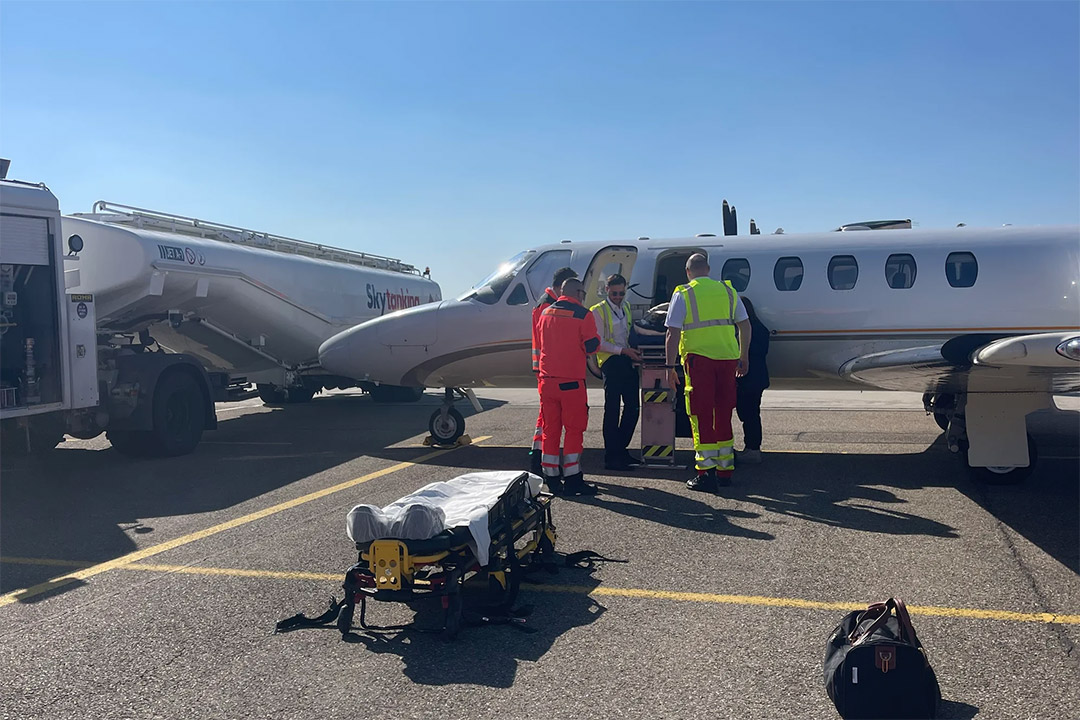
MTI 24/7 strategically plans each route to balance patient safety, fuel efficiency, and medical needs. The primary USA-to-India corridors our medical jets operate include:
New York to Delhi (14-16 hours nonstop): Fastest USA-to-India corridor using direct great circle route. Ideal for patients requiring cardiac, trauma, transplant, and neurosurgical care at Delhi's premier centers (Max Super Specialty, Apollo, Fortis).
New York to Mumbai (15-17 hours nonstop): Reaches India's financial capital specializing in cardiac, oncology, and infectious disease treatment at top-tier hospitals (Lilavati, Kokilaben Dhirubhai Ambani, Apollo).
Chicago to Delhi (14-15 hours nonstop): Slightly shorter transatlantic crossing reduces patient fatigue; established medical coordination with Delhi's leading trauma and critical care centers.
Los Angeles to Delhi (17-19 hours with strategic fuel stop): West Coast departures include one refueling stop in Europe (London, Shannon) or Middle East (Dubai, Doha) with pre-positioned ground ambulance for seamless patient continuity to Delhi's specialized facilities.
Los Angeles to Mumbai (18-20 hours with strategic fuel stop): Popular for West Coast patients requiring cardiac and cancer treatment; Gulf region fuel stop includes coordinated ground ambulance to Mumbai's leading tertiary centers.
San Francisco to Bangalore (18-19 hours with strategic fuel stop): Alternative southern India route serving patients requiring advanced cardiac, oncology, and neurosurgical care at Bangalore's specialized medical centers (Manipal, Apollo, St. John's).
MTI 24/7 medical flight coordinators assess patient stability, equipment requirements, and weather patterns to determine optimal routing. Patients on mechanical ventilation, ECMO, or continuous IV medications travel nonstop to minimize equipment disconnection risks; stable patients may accept strategic fuel stops if crew rest or weather avoidance improves overall safety margins.
Air ambulance cost breakdown and pricing factors for USA-to-India medical transport
Air ambulance pricing varies based on aircraft availability, timing, and routing complexity. MTI 24/7 breaks down each cost component transparently; all prices are customized according to patient medical needs, and we provide free, non-binding quotes so families can plan with confidence.
Base cost: $50,000-$80,000 for nonstop flights; $40,000-$65,000 for routed flights with strategic fuel stops. Includes ICU-equipped aircraft, dual medical crew (physician + nurse), 16–20-hour flight duration, and ground ambulance coordination at origin and destination.
Cost factors:
Distance and fuel: Longer routes require additional fuel reserves and crew time; nonstop routing maximizes efficiency.
Aircraft type: Aircraft selection depends on patient medical complexity, family accompaniment, and equipment requirements; larger cabin jets accommodate more life support systems and medical personnel.
Medical crew specialization: Basic crew (physician + critical care nurse) included in base cost; specialized teams (interventional cardiologist, intensivist, neonatologist) are available for complex cases.
Specialized equipment: ECMO machines, renal replacement therapy, advanced airway management, and other critical care systems are configured based on patient condition.
Ground ambulances: Ground transport at departure airport (USA) and arrival airport (India); standby ambulances are available if weather or mechanical delays occur.
Insurance coverage: Travel medical insurance typically covers medical transport costs; standard health insurance coverage varies by policy and medical necessity documentation.
MTI 24/7 always strives to find the most cost-effective solution for our patients without compromising medical quality, crew credentials, or aircraft safety standards. We provide all required documentation and detailed cost breakdowns that you can submit directly to your insurance provider to pursue maximum coverage and reduce your financial burden.
Why direct medical jets are preferred to commercial flight medical escorts
Direct air ambulances eliminate critical gaps that compromise patient safety during long-distance medical transport. MTI 24/7 operates dedicated medical jets because they provide uninterrupted intensive care; the clinical difference between patients arriving stable versus arriving in crisis:
Continuous ICU-level care without interruption: Our medical jets maintain hospital-equivalent equipment for 16+ hours without disconnection. Commercial escorts require 2-5 minute equipment disconnections during boarding and transfers, potentially causing hypoxia, bradycardia, and cardiac arrhythmia in life-support patients.
Optimized cabin pressure at sea-level equivalent: Our medical jets maintain sea-level cabin pressurization rather than the 8,000-foot equivalent of commercial airliners, preventing neurological deterioration in stroke patients and ischemic episodes in cardiac patients.
Zero infection exposure: Commercial flights expose immune-compromised patients to 200+ strangers where airborne pathogens transmit easily. Our medical jets carry only medical crew and family, eliminating nosocomial infection risk.
Bypasses airport procedures that destabilize patients: Our jets depart from fixed-base operators, avoiding TSA screening, security queues, and procedures that trigger blood pressure crashes in patients on vasopressors or sedation.
Eliminates multiple transfer points: Commercial escorts require wheelchair transfers, ground ambulances, and ER queues at connecting cities, introducing infection risk and mechanical complications. Our direct flights eliminate 3-4 transfer events where 8-12% of critically ill patients experience preventable complications.
Adaptive medical management: Our physicians adjust sedation, vasopressor rates, and ventilator settings every 15-30 minutes based on patient response. Commercial escorts follow rigid protocols that cannot accommodate individual patient variation.
Direct access to specialized hospitals: Commercial flights land at hub airports forcing 45–90-minute ground transfers to specialty centers. Our medical jets can land adjacent to specialized hospitals, reducing ground transport to 10-15 minutes; essential for evolving strokes or extending myocardial infarctions.
Redundant equipment and fail-safe systems: Our medical jets carry backup ventilators, redundant oxygen systems, and backup power supplies. Commercial aircraft lack redundancy.
Commercial medical escorts suit stable, chronic patients; direct medical jets suit critically ill patients requiring uninterrupted life support. MTI 24/7 recommends our medical jets for patients on mechanical ventilation, ECMO, inotropic support, post-operative complications, or any condition requiring real-time clinical adjustment during transport.
Ready to arrange safe medical transport?
Contact MTI 24/7 for a free, non-binding consultation. Our medical coordinators will assess your situation, answer all questions, and help you select the transport option that best protects your loved one's health and safety.
Reach us by:
Phone: USA: +16463350683 / UK: +442036080959
Email: info@mti-247.com
Our contact form