:quality(80) "header-bed-to-bed")
:quality(80) "air-ambulance-helicopters")
When a patient requires air medical transfer, choosing the right mode of transportation is not simply a logistical decision. The type of aircraft used can directly affect patient comfort, onboard medical care, transfer efficiency, and overall transport safety. Helicopters and fixed-wing air ambulances both play important roles in modern medical aviation, but each aircraft is designed for very different operational situations. Selecting the wrong option may increase patient fatigue, complicate in-flight treatment, delay access to specialized care, or expose medically vulnerable patients to avoidable transport risks. MTI 24/7 coordinates medically supervised helicopter and fixed-wing transfers worldwide for stabilized patients requiring safe, structured bed-to-bed transport.
Fixed-wing vs helicopter air ambulance: Essential takeaways
Helicopter air ambulances are mainly used for shorter regional transfers where rapid access and flexible landing locations are important.
Fixed-wing air ambulances are generally more suitable for long-distance and international medical transport requiring extended onboard care.
The most appropriate aircraft depends on the patient’s condition, transfer distance, medical requirements, and transport environment.
What is a fixed-wing air ambulance?
A fixed-wing air ambulance is a medical aircraft with wings, similar in structure to a private jet or small aircraft, adapted to carry a patient safely under medical supervision.
They are often selected when the patient needs to travel farther than would be practical by road or helicopter, especially across countries or between distant regions.
For example, a fixed-wing air ambulance may be used when:
A patient recovering after surgery cannot sit upright on a commercial flight.
A patient becomes seriously ill abroad and needs to return home for continued care.
A hospitalized patient must be transferred to another country for specialist treatment.
A ventilated or high-dependency patient needs medical supervision during a long journey.
Unlike a helicopter, fixed-wing air ambulances :. They need an airport or airstrip for departure and arrival. This is why they are mainly used for planned medical transfers where the patient has already been stabilized and the route can be carefully coordinated in advance.
What is a helicopter air ambulance?
A helicopter air ambulance is a specially equipped aircraft designed to move patients rapidly over short regional distances while maintaining continuous medical supervision during the flight.
Because helicopters can take off and land without a runway, they are particularly useful in areas where airport access is limited or where road transfer times would be medically impractical.
In organized medical transport, helicopters are typically used after the patient has been stabilized and requires faster access to a higher-level medical facility.
For example, helicopter transfers may be arranged when:
Road infrastructure is limited.
Airport access is unavailable nearby.
Geographic obstacles slow conventional transport.
A patient must reach a regional specialist center swiftly.
Helicopter air ambulances are mainly used for regional transfers rather than long international flights. Their ability to reach hospitals, isolated areas, and dedicated helipads quickly makes them particularly valuable when accessibility and transfer time are essential considerations.
How far can an air ambulance fly?
Flight range is one of the main operational differences between helicopters and fixed-wing air ambulances. While both aircraft can transport patients under medical supervision, they are designed for very different types of journeys.
Helicopters: designed for regional coverage
Medical helicopters are primarily used for shorter transfers where rapid regional access matters more than long-range flight capability.
Their main advantage is flexibility of access. Because they can land without a runway, helicopters are particularly useful in locations where airport infrastructure is unavailable, difficult to reach, or too far from the patient’s location.
They are often used when:
Geographic terrain limits conventional access.
An island patient requires mainland hospital care.
Ground transport would involve excessive travel time.
A patient must be transferred between nearby hospitals.
A regional facility cannot provide the required level of care.
However, helicopters are not intended for prolonged long-distance transport. As flight duration increases, operational constraints become more significant, including:
Limited flight range.
Higher cabin noise and vibration.
Reduced onboard movement space.
Greater sensitivity to weather conditions.
More physically demanding travel conditions.
For patients requiring prolonged monitoring or greater in-flight stability, these limitations may affect overall transport suitability.

Fixed-wing air ambulances: built for long-distance transport
Private medical jets are designed for sustained medical flights over much larger distances.
They are commonly used for:
Long-haul ICU transport.
Cross-border hospital transfers.
Overseas specialist treatment transfer.
Compared to helicopters, fixed-wing aircraft can generally travel farther and faster while maintaining more stable flight conditions during extended journeys. This allows medically supervised transport across regions, countries, and continents with fewer operational interruptions.
The flight environment may also be more suitable for patients requiring:
Respiratory support.
Strict immobilization.
Continuous medical observation.
Extended critical care supervision.
In many medical transfer plans, helicopters and fixed-wing aircraft work together rather than replacing one another. A helicopter may complete the shorter regional segment before a fixed-wing air ambulance carries the patient over a much longer international distance.
How do onboard medical capabilities differ between helicopters and fixed-wing air ambulances?
Both helicopters and fixed-wing air ambulances can provide advanced medical care during patient transport, but the onboard environment differs considerably because the aircraft are designed for different types of missions.
Rather than one aircraft being “better” than the other, each platform is adapted to specific transport conditions, flight durations, and medical requirements.
Medical helicopters: compact platforms for shorter transfers
Helicopter air ambulances are designed for regional medical transport where accessibility and shorter transfer times are prioritized.
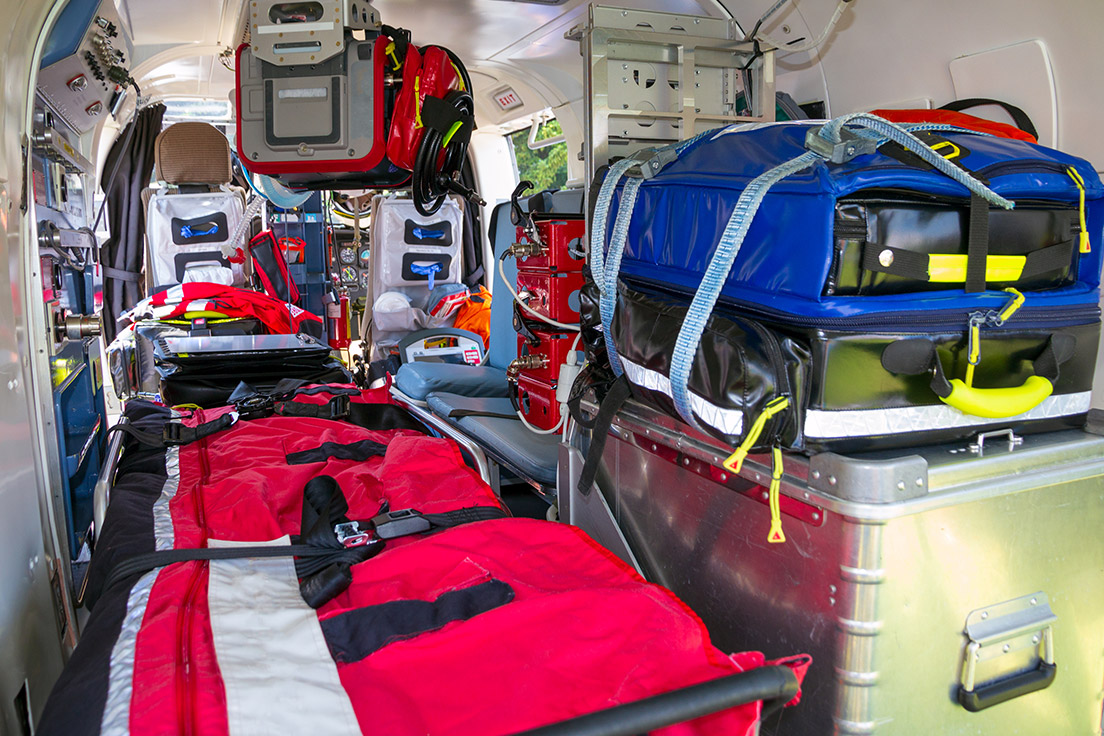
Because helicopters are smaller aircraft, onboard medical space is naturally more limited than inside fixed-wing air ambulances. Medical teams therefore work within a more compact treatment environment during the flight.
Despite these space limitations, helicopters can still support high-level medical transport with equipment such as:
Defibrillators.
Infusion devices.
Cardiac monitors.
Portable ventilators.
Emergency medication.
Oxygen delivery systems.
However, the cabin layout may restrict:
Complex in-flight procedures.
Large ICU equipment installation.
Crew movement during treatment.
Extended critical care management over longer durations.
For this reason, helicopters are generally more suitable for shorter medically supervised transfers where the patient’s condition can be managed safely within a more compact flight environment.

Fixed-wing air ambulances: adapted for extended critical care transport
Fixed-wing air ambulances usually offer a larger and more structured medical environment during longer journeys. The additional cabin space allows medical teams to work more comfortably around the patient while integrating more advanced critical care equipment when required.
Depending on the mission, air ambulance aircraft equipment may include:
Isolation systems.
Multiple infusion pumps.
Extended oxygen reserves.
Advanced ventilator systems.
Specialist intensive care staffing.
Continuous hemodynamic monitoring.
The larger onboard workspace may also facilitate:
Patient repositioning.
Airway access during flight.
Long-duration ventilation management.
Continuous treatment during international transfer.
Some fixed-wing aircraft can even be configured similarly to mobile intensive care units for patients requiring continuous advanced monitoring throughout transport.
When is helicopter medical transport more suitable?
Helicopter air ambulances are often selected when the challenge is not the medical flight itself, but the difficulty of reaching the patient or reducing total transfer complexity within a smaller geographic area.
In many situations, the advantage of a helicopter is logistical efficiency rather than flight distance.
For example, a patient may technically be only 80 kilometres away from a specialist hospital, yet:
Ferry connections may delay island transfers.
Road traffic could turn the journey into several hours.
Mountain roads may slow ground ambulances considerably.
The nearest airport may still be too far from the patient’s actual location.
In these situations, a helicopter may simplify the overall transfer pathway by connecting the patient more directly to definitive care.
Helicopters are also particularly useful when multiple stages of transport would otherwise be required.
For instance:
A regional hospital with limited ICU capability may require rapid transfer to a tertiary center before the patient’s condition deteriorates further.
A patient in an offshore industrial area may be transported directly to a mainland hospital instead of undergoing several intermediate transport transitions.
A patient on a small island may first need ground transport to a port, then ferry transfer, then another ambulance journey to hospital. A helicopter can sometimes reduce these separate transfer stages into a single coordinated flight.
Another important advantage is transfer continuity. Reducing repeated loading and unloading between vehicles may improve comfort for:
Spinal injury patients.
Post-operative patients.
Patients with severe fractures.
Patients sensitive to movement or repositioning.
In some cases, the shorter direct routing offered by helicopters may also help hospitals free critical care capacity faster by accelerating interfacility transfer coordination.
When is a fixed-wing air ambulance more suitable?

Fixed-wing air ambulances are often chosen when the medical journey itself becomes the central challenge rather than simple geographic access. This is particularly true when a patient must remain under medical supervision for several hours, cross international borders, or continue treatment safely while travelling over a large distance.
In many cases, the objective is not only to transport the patient, but also to maintain continuity of care throughout a prolonged and medically complex journey.
For example:
A ventilated patient may need continuous ICU-level monitoring during a multi-hour international flight.
A patient considered unfit for commercial travel may require a fully medicalised aircraft environment instead.
A critically ill patient may require transfer to another country for a highly specialised treatment unavailable locally.
Another important factor is endurance. Some patient transfers involve several consecutive hours of onboard medical supervision, oxygen therapy, ventilatory support, or continuous monitoring. Fixed-wing aircraft are generally better adapted to maintaining these conditions over extended flight durations.
In many international cases, fixed-wing air ambulances become the central segment of a larger coordinated transfer pathway linking hospitals, ground ambulances, and specialist medical teams across multiple locations.
Helicopter vs fixed-wing air ambulance costs
Air ambulance pricing can vary significantly because every medical transfer involves different clinical, operational, and logistical requirements.
The final cost is not determined by distance alone. The patient’s condition, required medical support, aircraft type, routing complexity, and international coordination needs may all influence the overall transport plan.
Factors that may affect all air ambulance missions
Both helicopter and fixed-wing medical transport costs may depend on:
Total transport distance.
Oxygen and monitoring needs.
Medical staffing requirements.
Required level of onboard care.
The patient’s medical condition.
Bed-to-bed service coordination.
Factors more specific to helicopter medical transport
Helicopter medical flights may be more affected by terrain accessibility, landing conditions, regional weather exposure, and shorter operational range. Geographic isolation, island transfers, and offshore routing may also influence mission planning and aircraft availability.
Factors more specific to fixed-wing air ambulances
Fixed-wing medical transport may involve additional coordination linked to international routing, airport logistics, refuelling stops, and cross-border administrative procedures. Longer journeys may also require more extensive onboard medical planning for continuous patient care.
At MTI 24/7, every medical flight is coordinated individually according to the patient’s condition, medical needs, transport route, and operational requirements. We always provide free, non-binding quotations tailored to each specific transfer request.
Need help choosing the right medical aircraft?

Selecting between a helicopter and a fixed-wing air ambulance depends on the patient’s condition, travel distance, medical requirements, and transfer environment. MTI 24/7 coordinates medically supervised bed-to-bed transport solutions worldwide and can help determine the most appropriate aircraft for each situation. Contact our team 24/7 for a free, non-binding medical transport assessment.
Reach us by: