:quality(80) "header-bed-to-bed")
:quality(80) "Cost of MTI 24/7's medical transport services")
Medevac cost essentials: what you need to know before booking
Medevac cost is shaped by mission specifics, including distance, aircraft type, level of in-flight medical care, ground transport, and the urgency of the transfer.
Insurance coverage varies widely, depending on the policy and on the medical necessity of the transport.
MTI 24/7 provides free, customized, non-binding quotes, coordinating safe bed-to-bed medical evacuations worldwide, 24 hours a day, with full transparency on every cost.
Intro: A child diagnosed with a rare condition that only three hospitals in the world can treat. A parent who needs life-saving surgery available abroad. A patient whose recovery depends on reaching a specialist thousands of miles away. Medical evacuation, or medevac, is the lifeline that makes these journeys possible, safely moving patients from one country or city to another for better, more specialized care. The price of such a mission is shaped by a precise combination of medical, logistical, and aviation factors. At MTI 24/7, we coordinate these transports worldwide with calm expertise, every hour, every day.
What is included in medevac pricing? The real factors behind the cost of a medical evacuation
The price of a medevac is built around the realities of each mission. It reflects the patient's clinical situation, the route, and the medical resources required in flight. None of these factors inflate the bill on their own; they simply allow our teams to tailor a transport that is safe, efficient, and proportionate to actual needs.
Below is how each element shapes the cost of a medical evacuation.
1. Distance and geography: domestic vs international medical transport
Distance plays a natural role in medevac pricing, but its influence is measured.
Domestic medical transports (within the same country) involve shorter flight durations and lighter administrative coordination.
International medical evacuations may require long-range aircraft, fuel stops, overflight permits, and customs clearance in several countries.
Geography also shapes logistics. A transfer between two major hubs flows more smoothly than one involving a remote airfield or a region with limited aviation services.
In certain cases, several modes of transportation must be combined to reach the patient and complete the journey safely, for example, an air ambulance helicopter may be dispatched to collect the patient from an isolated location and bring them to a nearby airport, where a fixed-wing air ambulance or a commercial flight with a medical escort takes over for the long-haul segment. Ground ambulances then ensure the final bed-to-bed transfer at each end.
Our role is to orchestrate these moving parts so they remain seamless and proportionate, wherever the patient may be.
2. Aircraft type: air ambulance vs commercial flight with medical escort
The aircraft selected for a mission is matched to the patient's medical stability, never the other way around. Choosing the right option is often what keeps a medevac clinically appropriate and financially reasonable.
Dedicated air ambulance (private medical jet)
A fully equipped air ambulance functions as an airborne intensive care unit. It is suited to:
Unstable or intensive-care patients
Patients requiring continuous in-flight monitoring
Stretcher transports for patients unable to sit upright
Time-sensitive missions requiring direct point-to-point flights
Cases involving ventilation, infusion pumps, or advanced life support
Because the medical jet is dedicated to a single patient with a complete medical team on board, this solution is the most comprehensive, and it is recommended only when the clinical picture truly calls for it.
Medical escort on a commercial flight
For medically stable patients, a medical escort on a scheduled airline offers a safe, comfortable, and significantly more economical alternative. It typically involves:
In-flight oxygen and other approved medical equipment
A flight nurse, paramedic, or physician traveling with the patient
Business class, first class, or stretcher configuration depending on the airline
Selecting between an air ambulance and a commercial medical escort is always a joint decision with treating physicians, balancing safety, comfort, and cost.

3. Level of in-flight medical care
The clinical complexity of the patient shapes the medical setup on board. Each mission is staffed and equipped to match real needs, nothing more, nothing less. This may include:
A full medical flight crew on air ambulances for critically ill or injured patients: typically composed of an intensive care physician and a flight nurse or paramedic, supported by additional specialists when the case requires it (neonatologists, cardiologists, anesthesiologists, infectious disease experts).
A single or double medical escort team on commercial flights for stable patients: usually a flight nurse, paramedic, or physician traveling alongside the patient, with a second escort added when the clinical situation calls for continuous monitoring or extended long-haul journeys.
ICU-grade equipment on board: ventilators, defibrillators, multi-parameter monitors, syringe drivers, suction units, and portable oxygen systems, with additional specialized equipment integrated whenever the patient's condition requires it, such as ECMO support, intra-aortic balloon pumps, or advanced cardiac monitoring.
Advanced medications and blood products carefully selected for each mission, including vasopressors, sedatives, anticoagulants, and emergency drugs prepared in advance to anticipate any in-flight clinical evolution.
Isolation protocols and biosafety measures for infectious or immunocompromised patients, with dedicated isolation pods, personal protective equipment, and ventilation management that meet international aeromedical standards.
Neonatal incubators and pediatric configurations for newborns and premature babies, paired with specialized neonatal nursing teams trained in high-altitude care, thermoregulation, and respiratory support for the most fragile patients.
A patient recovering from elective surgery requires a very different configuration than someone on continuous ventilation or extracorporeal support. By calibrating the medical flight crew, equipment, and clinical protocols precisely to each case, we avoid unnecessary costs while preserving full clinical safety.
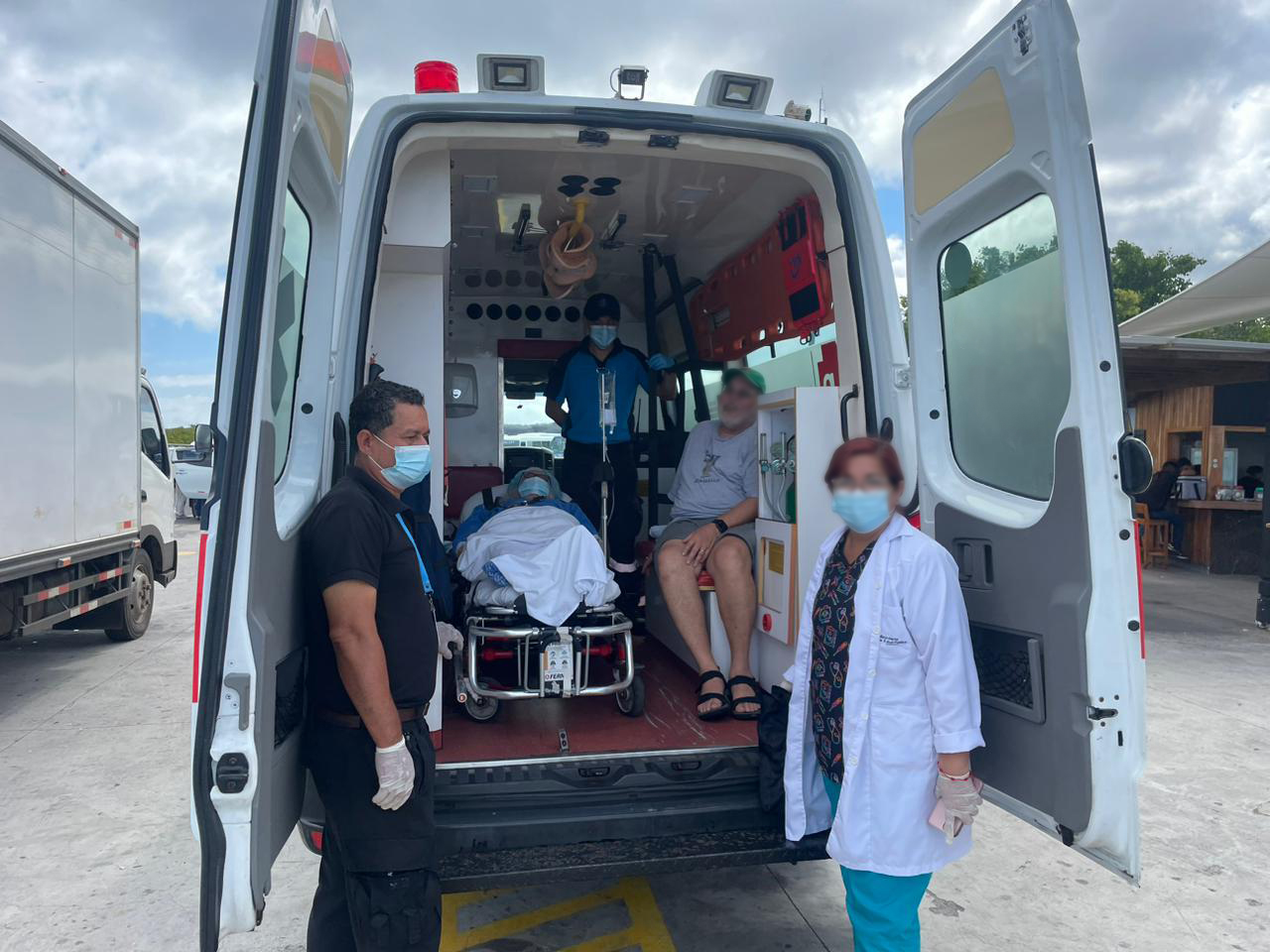
4. Ground transport and bed-to-bed coordination
A medevac does not start or end on the tarmac; it begins at the patient's hospital bed and ends at the receiving hospital bed. This continuity is the heart of true bed-to-bed medical transport, and it relies on a finely orchestrated chain of operations:
Ground ambulance pickup at the departing hospital, with the medical crew taking over care from the treating team and securing the patient for transfer.
Structured medical handover on the tarmac, where clinical information, medications, and monitoring continuity are passed seamlessly between ground and flight teams.
In-flight monitoring and care throughout the journey, maintaining the same standard of attention as in a hospital ward or intensive care unit.
Receiving ground ambulance waiting at the destination airport, ready for immediate transfer the moment the aircraft lands.
Direct admission coordination with the receiving medical facility, including pre-arranged bed availability, specialist notification, and full transmission of the patient's medical file.
Each of these segments is planned, timed, and supervised in advance by our operations and medical teams, often across multiple time zones and languages. This level of orchestration keeps the journey smooth for the patient and the family, while keeping the overall medevac cost predictable and proportionate, with no surprises along the way.
5. Urgent vs scheduled medevac missions: how timing influences the cost
The level of urgency shapes how a medevac is planned, priced, and executed. Every mission is treated with the same clinical rigor; what changes is the operational tempo behind it.
Urgent medevac missions are mobilized within the shortest possible window. Aircraft are placed on standby, medical crews are activated promptly, and overflight and landing permits are requested on an accelerated track. Every operational lever moves in parallel to reach the patient without delay, which naturally requires more intensive coordination behind the scenes.
Non-urgent or scheduled medical transports open the door to broader planning flexibility. Our teams can compare aircraft options, refine flight routes, secure favorable airport slots, and synchronize departure with the receiving hospital's admission window, all of which contribute to a smoother, more cost-efficient mission.
Whenever the clinical picture allows even a modest planning window, we use it to fine-tune logistics, anticipate every detail, and keep the overall medevac cost proportionate without ever slowing down a case that demands swift action.
Can travel insurance cover medevac expenses?
Medical flight insurance is often the first concern raised by families. Whether a medevac is covered depends on the type of policy held and the medical circumstances of the transport.
Types of insurance that may cover a medical evacuation
Several policies commonly include, or can be extended to include, medical transport benefits:
Private health insurance plans with international extensions
Premium credit card travel protections, occasionally offering limited medevac benefits
Medicare: in the United States, Original Medicare (Parts A and B) generally does not cover medical transport outside the U.S., and domestic coverage is limited to medically necessary ambulance services. Some Medicare Advantage (Part C) plans include broader benefits, sometimes extending to limited international emergencies; terms vary widely by plan.
When insurance typically covers a medevac
A medevac is usually reimbursed when:
The condition falls within the policy's scope
The policy includes evacuation to a specialized hospital
The local facility cannot provide the required level of care
The mission is pre-approved by the insurer's assistance team
The transport is medically necessary and confirmed by treating physicians
When insurance may not cover a medevac
Coverage may be reduced or declined when:
The destination is excluded by the policy
The policy has lapsed or reached its coverage ceiling
The case involves excluded activities or circumstances
Pre-existing conditions were not disclosed at subscription
The transport is deemed elective rather than medically necessary
When insurance does not apply, families, employers, and hospitals can still arrange a private medevac transport directly. A significant share of our missions is organized this way, with the same level of care and full transparency on costs.

Customized pricing and free, non-binding medevac quotes
No two patients share the same medical profile, route, or timing, so no two medevac quotes look alike. MTI 24/7 builds each estimate around the specific clinical, geographical, and operational realities of the mission.
Every quote considers:
Any insurance coordination needed
The timing and operational window
The departure and destination points
The most suitable aircraft and crew configuration
The patient's current medical condition and required in-flight care
Our quotes are fully customized, free, and non-binding. There is no obligation, no pressure, and no hidden cost. Whether the inquiry comes from a family, a hospital, or a corporate client, our role is to provide clarity and options, so that the decision rests with you, fully informed.
Contact MTI 24/7 to receive a personalized medevac quote
If you would like guidance, a second opinion, or a free, customized medevac quote, MTI 24/7 is available 24/7, worldwide. Our team will listen, assess, and propose a medical transport solution that fits your situation, without obligation. Contact our team to discuss your case and receive a personalized medical evacuation quote tailored to your needs.