:quality(80) "header-bed-to-bed")
:quality(80) "da-bastia-nuernberg-01")
When a patient requires medical transport but does not face life-threatening danger, a non-emergency medical flight offers a controlled, dignified alternative to commercial air travel or ground transport. Unlike emergency air ambulance services, non-emergency flights are planned in advance, coordinated with precision, and priced competitively based on actual medical and logistical needs. MTI's non-emergency medical flight coordination operates 24/7, allowing scheduling flexibility to match patient clinical requirements and family circumstances.
Non-emergency medical flight cost
Non-emergency medical transport includes two primary options: commercial flights with a medical escort or dedicated air ambulances, each suited to different patient acuity levels and medical requirements.
Commercial medical escorts cost significantly less than dedicated air ambulances because they use existing airline infrastructure, making them ideal for stable patients whose medical condition allows safe commercial travel.
Multiple factors drive pricing variation, including distance, aircraft type, medical complexity, staffing requirements, booking timing, and insurance coverage, all of which should be assessed during a free medical consultation.
MTI 24/7 provides transparent, non-binding cost estimates through a streamlined process that evaluates your patient's needs and delivers detailed itemized quotes without obligation or hidden charges.
What is a non-emergency medical flight?
A non-emergency medical flight is a planned medical transport where a patient travels by air with professional medical oversight, but the situation does not meet criteria for emergency transportation. The patient's condition is stable or predictable, and transport can be scheduled days or weeks in advance.
MTI 24/7’s non-emergency flights serve medical repatriation (returning patients home for ongoing care), inter-hospital transfer (moving patients to specialized treatment centers), post-operative transport, chronic disease management, and medevac from remote regions to facilities with advanced capability.
The key advantage: advance planning reduces cost and improves outcomes.
Air ambulance vs. Medical escort: NEMT transport options
Every patient transport decision balances clinical safety, operational logistics, and resource efficiency. The right choice depends on medical acuity, not budget constraints alone.
Medical escort on commercial flight
Our commercial medical escort service pairs a trained medical professional with your patient on scheduled airline flights.
The air medical escort monitors vital signs, carries pre-authorized portable medical equipment (oxygen, medications, monitoring devices), and coordinates with airline crew throughout the journey. This model works seamlessly for patients whose condition is stable and whose transport timeline aligns with existing flight schedules.
Best for:
This option works well for patients whose medical condition has stabilized after surgery or acute care. They no longer require intensive monitoring or specialized equipment but still benefit from professional medical oversight during travel.
Patients must be able to tolerate commercial cabin conditions: standard cabin pressure, seat positioning, and aircraft environment. Those requiring specialized stretchers, isolation equipment, or continuous ventilator support need a dedicated air ambulance instead.
Operational advantage:
By utilizing scheduled commercial aircraft rather than chartering private aircraft, MTI's medical escort model distributes operational costs across established airline infrastructure. This allows our resources to focus entirely on patient care coordination and medical monitoring, rather than aircraft operation and maintenance, resulting in more efficient resource allocation for your patient's transport needs.
Dedicated air ambulance
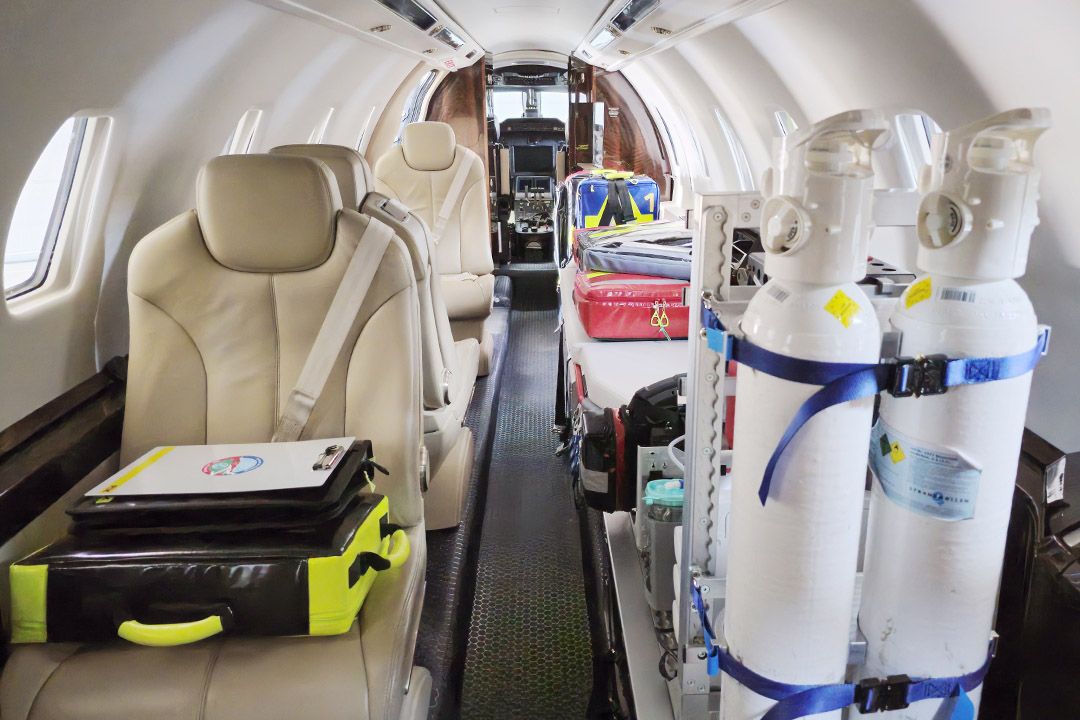
Our air ambulance service deploys a private aircraft configured exclusively for medical transport, equipped with stretchers, oxygen systems, cardiac monitors, ventilators, and ICU-level medical equipment.
The flight crew includes pilots and medical professionals (paramedic, nurse, or physician) trained in high-acuity patient management and in-flight medical intervention. This model enables direct point-to-point routing (whenever possible) without commercial flight constraints.
Best for:
Fragile patients whose medical condition is unstable or unpredictable require the full medical capability of a dedicated aircraft. These patients cannot safely tolerate commercial cabin pressure, seat positioning, or flight environment limitations.
Patients requiring continuous medical intervention, including mechanical ventilation, vasopressor support, or intensive monitoring, need ICU-level equipment and specialized medical staff on board. Complex spinal surgery, severe trauma, and advanced cancer patients require physician-level oversight and specialized positioning during transport.

Clinical advantage:
Dedicated air ambulances carry full ICU-level equipment and medications ready for rapid use. Physicians and critical care nurses provide continuous real-time monitoring and can intervene if the patient's condition changes during flight.
Direct routing allows the aircraft to depart from origin facilities and land directly at receiving hospitals, eliminating ground transport delays. This flexibility is critical for time-sensitive transfers and patients unable to access commercial airports.
Flight parameters can be adjusted to match the patient's medical needs, namely descent rate, cabin pressure, and routing, providing clinical control that commercial flights cannot offer.
How we determine the right service
Medical assessment, not convenience or cost, determines suitability. A physician familiar with the patient's condition evaluates respiratory stability, cardiac function, mobility, consciousness level, and isolation requirements. Our medical teams conduct this assessment in real-time, consulting with referring and receiving hospitals to confirm whether commercial flight is medically safe or whether air ambulance transport is clinically necessary. This ensures your patient receives appropriate-level care without unnecessary escalation or unsafe under-resourcing.
MTI's clinical coordinators are available 24/7 to assess your patient and recommend the optimal transport method.
What drives NEMT medical transport costs: main factors explained
Several measurable factors influence the cost of non-emergency medical transport. Learning about these elements helps you anticipate resource requirements and plan appropriately.
Distance and route:
Longer routes require more flight hours, fuel consumption, crew hours, and regulatory coordination across multiple jurisdictions. Regional transport (under 500 miles) involves simpler logistics than international routes (1,500+ miles), which may require crew rest stops, overnight positioning, or additional regulatory compliance.
Medical complexity and staffing:
A stable post-operative patient requires a nurse escort; a ventilator-dependent patient requires a physician and critical care team. Higher acuity demands more specialized expertise,: infectious disease isolation protocols, neonatal transport, or cardiac critical care, which reflects in staffing level and resource allocation. The scope of medical responsibility grows with clinical complexity.
Timing of transport:
Advance booking (7–14 days) allows standard scheduling and competitive resource allocation. When transport is not urgent, coordinators can identify the most suitable aircraft, negotiate rates across multiple providers, schedule crew efficiently, and align departure times with patient readiness and receiving hospital capacity. This flexibility reduces operational strain and allows teams to prioritize quality coordination over speed.
Urgent transport (24–48 hours) requires swift crew mobilization and aircraft availability management. When time is compressed, options narrow—fewer aircraft may be available, crew scheduling becomes rigid, and alternative routing solutions are limited. The compressed timeline increases operational complexity and resource demands, even when the patient's medical condition does not require emergency-level intervention.
Why commercial medical escort costs less than air ambulance

Commercial flight with a medical escort costs less than a dedicated air ambulance because you are using an airline's existing infrastructure and schedule. The medical escort is simply a trained professional traveling alongside the patient with portable equipment. A dedicated air ambulance, by contrast, requires chartering an entire aircraft and equipping it specifically for that single transport. For patients whose medical condition allows safe commercial travel, choosing a medical escort preserves resources and reduces overall transport expense.
Accurate cost assessment requires detailed medical and logistical information. MTI 24/7's coordinators evaluate your patient's specific needs and provide transparent, itemized quotes.
What is included in a non-emergency medical flight cost estimate
A detailed cost estimate breaks down exactly which services and items are bundled into your quote, and which may be separate, preventing surprises and allowing fair comparison across providers.
What to expect in your quote
Your cost estimate should clearly specify:
Aircraft and crew for the entire journey.
Portable medical equipment (oxygen, monitors, medications, IV supplies).
Medical staffing (nurse, paramedic, or physician as appropriate to patient acuity).
Items often invoiced separately
Depending on the transport type and complexity, you may see additional line items:
Ground ambulance service to and from airports.
Accommodation for medical escort (if overnight stop or crew rest required).
Specialist equipment (isolation chambers, advanced ventilators, neonatal incubators).
MTI 24/7 provides a free, non-binding itemized quote that details all services, equipment, and any separate charges, so you know exactly what your transport will include before making any commitment.
How to get an accurate NEMT medical flight cost estimate
MTI 24/7 streamlines the process of obtaining a customized, non-binding cost estimate. Our coordinators work quickly to provide transparent pricing based on your specific situation.
Step 1: Contact us
Reach out by phone, email, or our online contact form. Our multilingual team is available 24/7.
Step 2: Free consultation
Our medical transport specialists conduct a preliminary consultation to assess your patient's medical needs, current stability, origin and destination, and preferred transport timeline.
Information we'll need: Current diagnosis, mobility status, special medical requirements, origin and destination details, preferred date and time range, and insurance information.
Step 3: Receive your non-binding quote
We provide a detailed, itemized estimate that specifies the aircraft type, medical staffing, equipment, route, estimated flight time, all included services, and any separate charges.
Step 4: Confirm and transport
Once you review the quote and decide to proceed, we move to coordination and arrange your transport.
This streamlined approach ensures you have transparent pricing information and allows time for insurance verification and family decision-making before committing to transport.
Non-emergency medical flights offer safe, dignified transport for stable patients. Understanding your options, commercial escort versus dedicated air ambulance, helps you make informed decisions that balance medical necessity with cost efficiency. Advance planning and transparent assessment ensure the right solution for your situation.
Ask for a free NEMT quote
MTI 24/7 is available 24/7 to discuss your non-emergency medical flight needs. We provide free assessments and detailed cost estimates based on your patient's actual medical situation. Contact us to discuss your transport needs and receive a realistic cost estimate tailored to your circumstances.