:quality(80) "header-bed-to-bed")
:quality(80) "Medical Helicopter")
When faced with a medical situation requiring a short-distance transfer from a remote area or non-emergency transportation, a medical helicopter can be a suitable option. A medical helicopter has several uses, most of which can be beneficial to you or your loved one.
This article will cover how a medical helicopter works, its equipment and uses.
Key insights about a medical helicopter:
A medical helicopter is a specially equipped helicopter that is designed for rapid transport.
It is ideal for time sensitive situation and also to access remote areas.
Medical helicopters differ from fixed-wing air ambulance mainly in relation to the distance they can cover.
The medical crew onboard a medical helicopter includes a flight nurse, paramedic, and pilot.
Patients are often prepared for helicopter transport through meticulous stabilization.
MTI 24/7 offers safe, well-coordinated, and non-emergency medical flights worldwide.
What is a medical helicopter?
A medical helicopter, or air ambulance, is a specially equipped helicopter that is designed for rapid transport and critical care of patients. It serves as a mobile intensive care unit (ICU).
Key features of medical helicopters include:
Specialized staff, for example, flight nurses and critical care paramedics.
Advanced equipment to manage complex medical conditions.
Rapid response and accessibility, for example, bypassing traffic and landing in challenging terrain.
These helicopters are often referred to as HEMS (Helicopter Emergency Medical Service).
When are medical helicopters used in patient transport?
Medical helicopters are used to transport critically ill or injured patients when speed is crucial, ground transport is too slow, or access is difficult.
Key scenarios for helicopter use:
Time-critical situations, for example, transporting severe trauma patients and stroke victims to specialized centers within the critical first hour.
Remote access: reaching patients in rural, mountainous, or off-shore locations where ambulances cannot easily navigate.
Bypassing traffic, for example, transporting from accident scenes or smaller hospitals in dense urban areas when traffic delays are severe.
Inter-facility transfers for higher-level care.
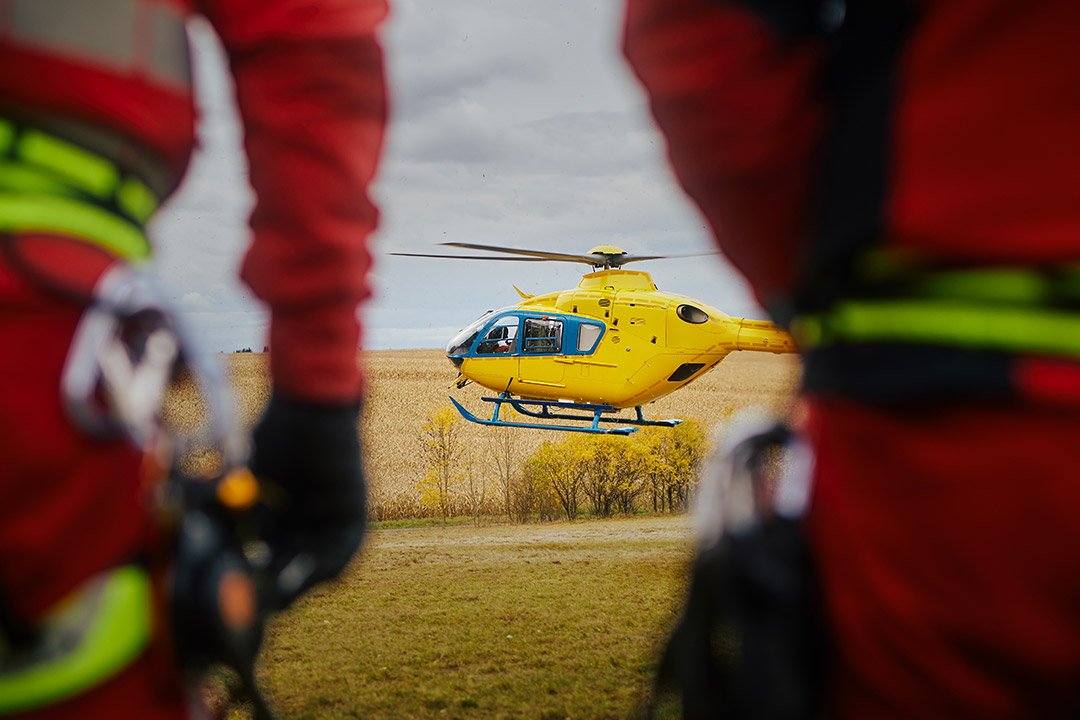
Medical helicopter vs. fixed-wing air ambulance: key differences
Medical helicopters differ from a fixed-wing air ambulance for various reasons.
Key differences between medical helicopters and fixed-wing ambulances
Feature | Medical helicopter | Fixed-wing air ambulance |
Range and distance | Short range, usually within 150-mile radius | Long-distance often over 150 miles or between states/countries |
Landing capability and accessibility | Highly agile, capable of landing in small spaces | Require runways for takeoff and landing |
Speed and altitude | Lower altitudes and slower | Faster and higher altitude |
Patient condition and cabin size | Non-pressurized cabins with limited space | Often pressurized with larger cabins |
Weather and limitations | Limited by poor weather conditions | Can fly in poor weather |
Uses | Remote scene accidents, transfer of patients quickly from small hospital to a major trauma center close by | Stable patients needing long-distance travel |
Medical crew and equipment on board a helicopter ambulance
A helicopter ambulance is designed to stabilize critically ill or injured patients. The crew provides immediate airway management, trauma resuscitation, and advanced cardiac support.
Medical crew:
Flight nurse/doctor, specifically trained in critical care transport and resuscitation
Paramedic experienced in emergency situations and advanced life support.
Pilot specially trained for air transport operations.
Key medical equipment:
Respiratory support,
Monitoring and diagnostics,
Trauma care,
Medical and fluid management, and
Transport and safety equipment.

How are patients prepared for helicopter medical transport?
Patients are often prepared for helicopter transport through meticulous stabilization. Generally, the patient is transferred to a specialized stretcher, strapped in, and dressed comfortably, while the medical staff packages records, medications, and equipment.
Patient stabilization preparation:
Airway and breathing, secured with appropriate devices
Circulation using relevant equipment
Monitoring of blood pressure and saturation
Medications are clearly labeled and documented for in-flight accessibility.
Physical and logistic preparation:
Stretcher transfer,
Packaging of the patient,
Documentation, and
Safety briefing.
What affects the cost of a medical helicopter flight?
The cost of a medical helicopter flight is primarily driven by distance, medical team, specialization, and the urgency of the transport.
Key factors influencing cost include:
Distance and duration: Longer flights increase fuel and labor costs
Level of care: The medical condition of the patient and the required crew expertise to transport them safely.
Urgency and timing: Immediate deployment, night or holiday flights often influence the overall price.
Fuel and aircraft type: High fuel consumption and maintenance of specialized equipment can increase expenses.
Ground condition: It often includes bed-to-bed service, adding to the overall cost.
Insurance coverage: Inadequate coverage can lead to higher prices.
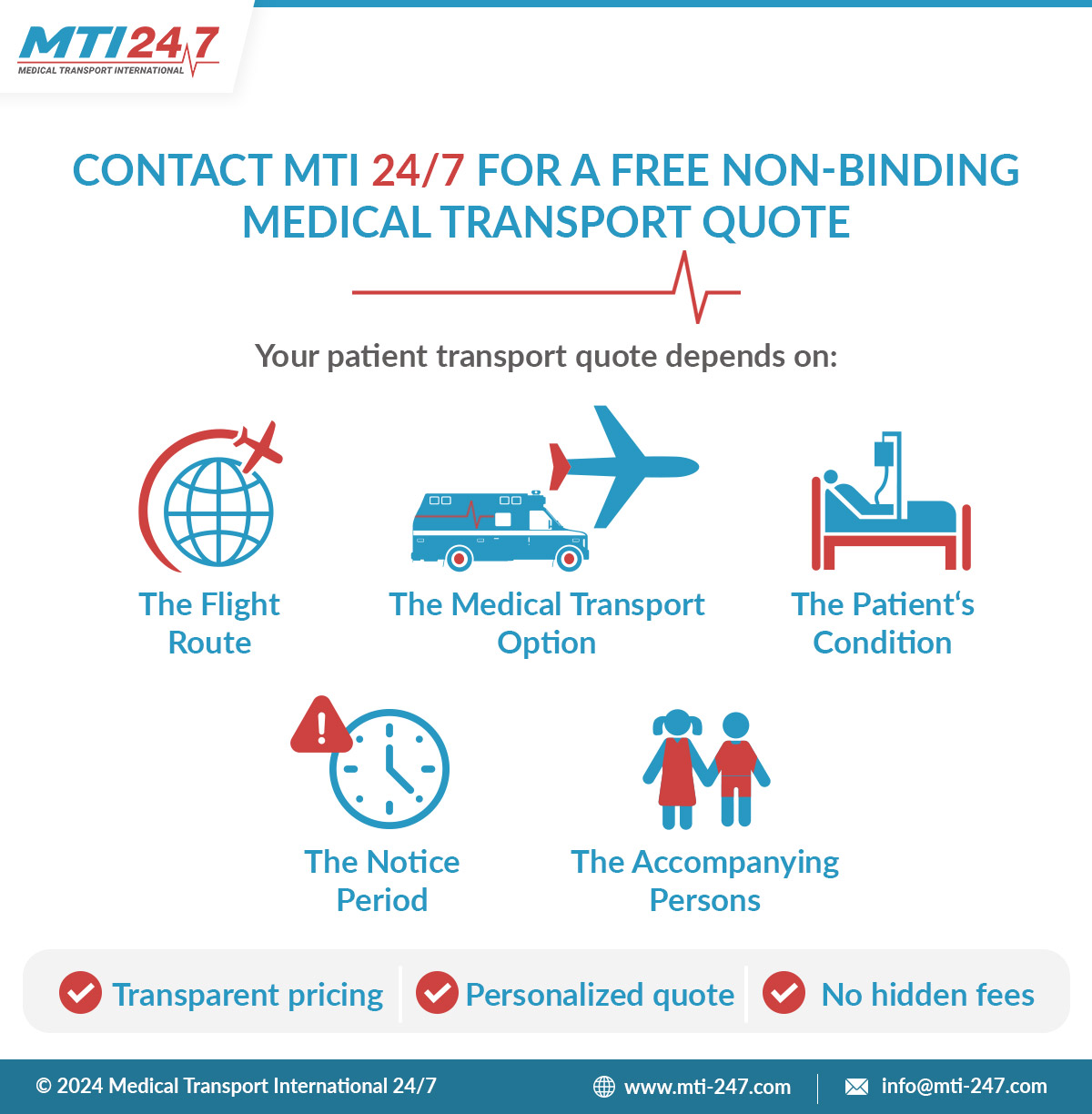
How to request a medical helicopter transport service?
Before you request a medical helicopter transport service, ensure you verify if the service provider has a good reputation, a specialized crew, and a proven track record of safe medical helicopter patient transfers.
Once you've ascertained this, you can proceed to contact them to get a customized quote for a medical helicopter transport.
MTI 24/7 has a multilingual team, a specialized crew, and a track record of providing safe medical helicopter transport service for patients worldwide.
Contact MTI 24/7 for Safe and Reliable Medical Helicopter Transport
If you need a reliable medical helicopter provider, MTI 24/7 offers safe, well-coordinated, and non-emergency medical flights worldwide. Our team ensures a smooth experience from initial contact to final destination with complete peace of mind.