:quality(80) "header-bed-to-bed")
:quality(80) "An air ambulance mid-flight")
Medical emergencies do not follow borders. When a patient requires urgent long-distance transport with hospital-level medical care, air ambulance jet services provide ICU-equipped aircraft staffed by experienced medical professionals. This guide explains when air ambulance jets are necessary, their medical capabilities, cost factors, how they compare to other transport options, and how MTI 24/7 can help you coordinate safe, seamless medical transport anywhere in the world.
Air ambulance jet services:
Air ambulance jets provide ICU-level care with specialized equipment and trained crews available 24/7 for complex medical conditions requiring long-distance transport.
Costs are customized based on distance, aircraft type, medical complexity, and crew needs; MTI 24/7 provides transparent quotes after assessing your specific requirements.
Air ambulance jets are appropriate when other transport options cannot safely meet patient needs due to distance, medical complexity, or time sensitivity.
What is an air ambulance jet?
An air ambulance jet is a fixed-wing aircraft configured as a flying intensive care unit, equipped with advanced medical monitoring, life-support systems, and staffed by licensed aeromedical professionals. Unlike commercial aircraft, these jets provide continuous critical care during flight, allowing safe transport of patients who cannot tolerate standard airline travel.
MTI 24/7's medical jets are equipped similarly to a modern ICU ward, with the ability to make adjustments if you require specialized medical equipment unavailable on board, including isolation units or pediatric pods. Our aircraft maintain sea-level cabin pressure, a critical feature for patients with respiratory problems, air-filled cavities, or recent surgical interventions where pressure changes could cause complications.
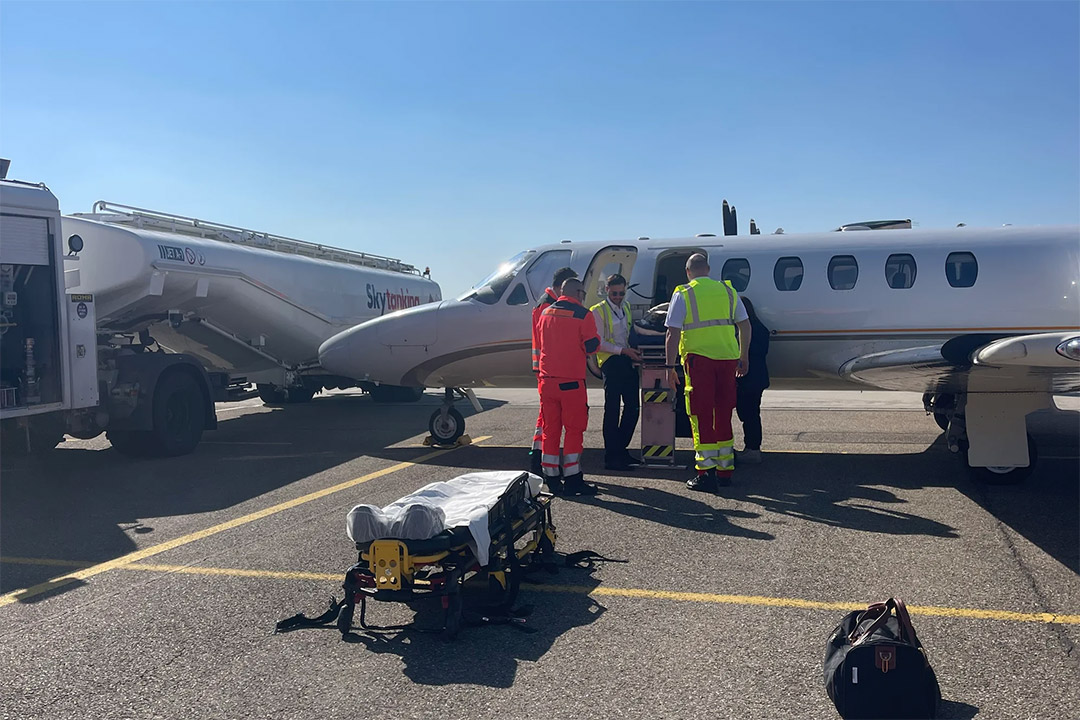
Domestic vs. International jet transport
Air ambulance jets are optimized for both medium and long-distance medical transport. They can cover intercontinental distances with strategic fuel stops, access smaller regional airports closer to medical facilities, and operate 24/7 with round-the-clock availability, eliminating the rigid scheduling constraints of commercial aviation.
Domestic transport
Domestic air ambulance jet transport moves patients within a single country, typically covering up to 1,500 miles with flight times under 4 hours. Domestic flights use regional airports closer to origin and destination hospitals, reducing ground transport time on both ends. These missions involve straightforward coordination between MTI 24/7 and the origin and destination medical facilities, with minimal regulatory complexity.
International transport
International flights move patients across borders and continents, often requiring 8–20+ hours depending on distance. Longer flights create greater medical demands, extended time in a pressurized cabin increases dehydration, medication timing becomes complex across time zones, and physiological stress accumulates. For this reason, international transport requires more comprehensive medical equipment and experienced flight crews to prevent complications that extended transit can trigger.
MTI 24/7 coordinates directly with both origin and destination healthcare systems, ensuring seamless care continuity and managing the logistical complexity of international medical transfer so families can focus entirely on their patient's wellbeing.
Our worldwide patient transport services are designed to cover both short and long distances, with the ability to land at small airstrips and major international airports, allowing us to reach even remote locations.
Who needs medical jet transport?
Air ambulance jets are appropriate when time, distance, or medical complexity create urgency that commercial flights or ground ambulances cannot safely manage.
Certain medical conditions and situations demand the specialized capabilities of air ambulance jets. Time-sensitive emergencies, long-distance transport requirements, and need for continuous ICU-level care during flight determine whether dedicated medical aircraft becomes necessary for safe transport.
Common medical conditions requiring air ambulance jets:
Organ transplant transport
Patients on mechanical ventilation
Cardiac emergencies and heart patients
Severe burns requiring specialty centers
Acute stroke requiring specialist intervention
Highly contagious conditions requiring isolation units
Respiratory diseases and oxygen-dependent patients
Bedridden patients unable to travel by commercial flight
Patients with terminal illnesses requiring specialized care
Post-surgical complications requiring intensive monitoring
Unstable vital signs requiring continuous critical medication
Renal failure patients requiring dialysis support during transport
These medical conditions often give rise to two distinct transport needs. Medical repatriation brings patients home to their country of origin for recovery or ongoing care, offering access to familiar healthcare systems, proximity to loved ones, continuity with known medical providers, and financial protection from high treatment costs abroad. Medical evacuation transports patients to distant specialty centers or advanced facilities when local healthcare cannot provide necessary treatment.
When you contact MTI 24/7, our medical director reviews your situation to confirm that air ambulance jet transport is medically appropriate and necessary for your specific needs.

Air ambulance jet vs. Other medical transport options
Air ambulance jets provide ICU-level care, continuous medical monitoring, pressurized cabins, advanced life-support equipment, and access to regional airports, capabilities suited for patients requiring intensive support during long-distance transport.
Helicopters
Helicopter transport excels for short-distance hospital-to-hospital transfers in urban environments, eliminating ground transfers to airports and providing rapid point-to-point movement. Helicopters are most practical for distances under 200 miles.
For longer distances, international transport, or when weather conditions restrict helicopter operations, air ambulance jets become the appropriate choice. Our medical jets maintain capability across broader geographic areas and weather conditions that ground helicopters cannot reliably serve.
Ground ambulances
Ground ambulances provide cost-effective transport for shorter distances and medically stable patients. They work well for regional transfers where travel time is manageable and continuous ICU-level monitoring is not essential.
For longer domestic distances, typically beyond 300–400 miles, or international transport, ground travel extends journey time significantly (8–48+ hours or more), which can compromise patient stability. Air ambulance jets reduce transport time substantially, becoming necessary when distance or patient acuity makes prolonged ground travel inadvisable.
Commercial airline medical escorts
Medical escorts on commercial flights also offer a cost-effective alternative for medically stable patients who can tolerate standard airline conditions and seating. A nurse or paramedic accompanies the patient, providing medication management and basic medical monitoring throughout the journey.
This option is unsuitable for patients requiring mechanical ventilation, continuous ICU-level care, isolation protocols for infectious diseases, or complex medical equipment. MTI 24/7 offers medical escort services for patients meeting stability criteria, reserving air ambulance jets for patients whose medical complexity exceeds what commercial flight environments can safely support.
Medical equipment and staffing differences
Air ambulance jets operated by MTI 24/7 carry comprehensive ICU equipment tailored to patient needs. Aircraft feature multi-parameter patient monitors, transport ventilators, cardiac monitors and defibrillators, airway management tools, cardiac support pumps, newborn transport units with specialized pediatric monitoring, isolation units with air filtration, and portable dialysis equipment.
Our flight crews include certified flight nurses, paramedics, and flight physicians trained in aeromedical transport. They manage complex medical conditions during flight, respond to acute changes including cardiac arrest or respiratory failure, administer medications, maintain continuous vital sign monitoring, and coordinate with ground medical teams, clinical capabilities that exceed standard airline crew training and ground ambulance staffing.
How much does an air ambulance jet cost?
Air ambulance jet costs vary based on flight distance, aircraft type, medical crew composition, patient acuity, ground transportation, and timing, with MTI 24/7 providing customized, non-binding quotes with no hidden fees.
Each medical transport mission is uniquely customized to your specific needs and circumstances. Rather than fixed pricing, MTI 24/7 develops transparent, all-inclusive costs based on the combination of factors that define your individual transport.
Primary cost factors:
Flight distance: The primary cost driver, determining fuel consumption, crew duty time, and aircraft utilization hours.
Aircraft type: Different aircraft categories have varying operating costs; larger, longer-range jets provide more space for medical equipment.
Patient medical complexity: Conditions determine the level of equipment and medical personnel involved. Critically unstable patients may require multiple specialists (physicians, critical care nurses, respiratory therapists).
Specialty equipment: Neonatal incubators, isolation units, bariatric equipment, or advanced cardiac/lung support devices based on specific patient requirements.
Ground transportation: Bed-to-bed ambulance coordination from current medical facility to departure airport and from arrival airport to receiving hospital.
Timing: Prompt availability may require diverting aircraft, while scheduled transport within 24–48 hours may optimize crew positioning and reduce expenses.
MTI 24/7 provides detailed cost estimates before flights begin, breaking down aircraft charges, crew fees, medical equipment, and ground services. We develop custom, non-binding quotes based on your exact requirements rather than generic estimates that may not reflect your actual transport scenario. All pricing is upfront and transparent, no hidden fees or unexpected charges.
Important: Insurance coverage varies. Some policies cover air ambulance jets fully if deemed medically necessary, others partially, and some require pre-authorization. MTI 24/7 works can help you clarify coverage options and ensure proper documentation for reimbursement claims.
MTI 24/7 air ambulance jet coordination process
When you contact MTI 24/7 to arrange air ambulance jet transport, our coordination team moves systematically to ensure safe, timely movement with continuous medical care and seamless bed-to-bed transfer.
Initial assessment and medical review
We gather essential information: patient's current location and condition, destination hospital, medical history, insurance details, and any special requirements (family accompaniment, specialized equipment, isolation needs). Our medical director reviews clinical information to confirm air ambulance jet transport is medically appropriate and necessary for your situation.
Aircraft and crew selection
We identify the optimal aircraft based on distance, patient acuity, and medical needs. Our medical crews are selected and briefed on your patient's condition, any special considerations, and the receiving hospital's requirements. All flights are operated by aviation-certified aircraft and staffed by licensed aeromedical professionals experienced in critical care transport.
Ground coordination
MTI 24/7 arranges ambulances to transport the patient from their current medical facility to the departure airport and from the arrival airport to the receiving hospital. We liaise directly with both hospitals to ensure smooth handoffs and verify that all medical records, imaging, and clinical information are available for the receiving team.
Medical handover and briefing
Our flight team receives detailed clinical handover from the origin hospital, including current vital signs, medications, recent imaging, clinical concerns, and any specific monitoring or intervention protocols required. This ensures no information gap during the transition to our care and allows our team to prepare optimal medical support.
Flight operations and continuous care

Our pilots optimize routing for safety and efficiency. Our medical crew provides continuous care matching patient needs throughout the flight, monitoring vital signs, adjusting medications as needed, managing any acute changes, and maintaining communication with ground-based medical teams and the receiving hospital. Our cabin design facilitates continuous patient access for the accompanying medical team, enabling ongoing treatment and monitoring throughout the journey.
Destination coordination and transfer
Upon arrival, we facilitate detailed clinical handover with the receiving hospital, ensuring all in-flight monitoring data, interventions, and medication changes are communicated. Ground transport to the patient's final destination is arranged seamlessly, and we maintain communication with families, and hospitals throughout the entire process, managing logistics invisibly so medical care remains the focus.
Dispatch timeline
MTI 24/7 coordinates air ambulance jet transport with a minimum of 48 hours to dispatch, allowing proper medical assessment, aircraft positioning, crew coordination, and all necessary regulatory and documentation preparations. For planned medical transport, this timeline ensures optimal coordination and cost efficiency. In urgent situations, our team works to facilitate the fastest possible deployment within this framework.
When a critically ill patient must travel long distances safely, air ambulance jet services provide the fastest and most medically capable transport available. They combine speed, ICU-level medical intensity, advanced life-support capabilities, and global reach to move patients safely when clinical urgency and distance demand specialized capability.
Arrange your air ambulance jet with MTI 24/7
MTI 24/7 coordinates global air ambulance flights with ICU-level medical care, experienced flight physicians and critical care nurses, advanced medical equipment, and seamless hospital-to-hospital transfer anywhere in the world. Our 24/7 team provides personalized coordination, transparent pricing, and complete documentation support for insurance reimbursement.
Reach us by: