:quality(80) "header-bed-to-bed")
:quality(80) "austria")
When a medical emergency unfolds far from home, or within Austria's own borders, the speed, precision, and coordination of a patient transfer can directly influence outcomes. Whether a tourist has suffered a stroke in the Alps, a resident needs urgent transfer to a specialist centre abroad, or a family needs to repatriate an ill loved one, the right transport solution must be identified and activated without delay. MTI 24/7 coordinates emergency and planned patient transfers to and from Austria, 24 hours a day, every day of the year.
Emergency patient transfers in Austria are required whenever a patient's condition demands a level of specialist care that the treating facility cannot provide. This applies equally to domestic inter-hospital transfers within Austria and to international medical flights across Europe and beyond.
The choice between a dedicated air ambulance and a commercial medical escort is always determined by the patient's clinical condition at the time of transfer. A dedicated aircraft with ICU-level equipment is reserved for patients who cannot safely travel on a scheduled commercial service, while a medical escort is appropriate for those who are stable but require professional supervision throughout the journey.
MTI 24/7 coordinates the full transfer chain bed-to-bed, managing aircraft positioning, medical crew assembly, and receiving hospital liaison simultaneously. Every quote is fully customised to the specific case, transparent, and provided free of charge with no obligation.
What is an emergency patient transfer?
An emergency patient transfer is activated when a patient's condition cannot wait. The treating hospital may lack the specialist capacity required, the patient may need repatriation urgently, or the medical situation may be deteriorating faster than local resources can manage. Time is the defining constraint.
A planned, or non-emergency medical transfer operates on a different logic. The patient is stable. The destination, timing, and transport method are selected for clinical appropriateness and comfort, not urgency. Planning windows of several days are normal. The coordination process is thorough rather than compressed.
The practical distinction matters because it shapes everything: which aircraft is sourced, how quickly the crew is assembled, whether commercial options are viable, and how the receiving hospital is engaged.
The two types of transfer are not simply fast and slow versions of the same service; they are fundamentally different coordination challenges. MTI 24/7 manages both, and the assessment of which category applies to a given patient is the first conversation our team will have with the referring hospital or family.
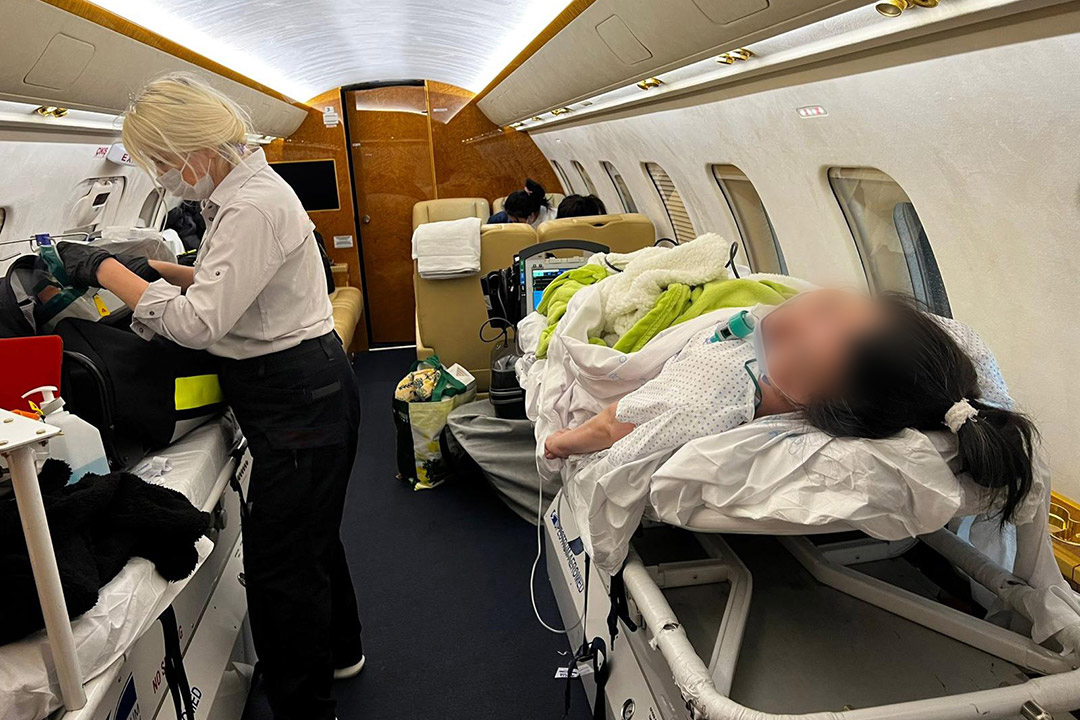
When is emergency patient transfer required? Common conditions and situations
Emergency medical patient transport is warranted whenever a patient's condition demands continuous in-flight monitoring or prompt transfer from a facility ill-equipped to manage their needs.
The threshold question is always the same: does the gap between what the current hospital can offer and what the patient actually needs create a clinical risk, and does time between transfer and treatment affect the outcome? If the answer to both is yes, an emergency patient transfer is indicated.
Conditions that most frequently require urgent transfer coordination from or within Austria include:
Sepsis with rapid organ dysfunction: where escalation of care cannot be delayed without worsening outcomes.
Spinal cord trauma with neurological deficit: where the window for surgical decompression is measured in hours, not days.
Acute liver failure: where rapid transfer to a transplant-capable centre can be the difference between survival and irreversible organ loss.
Severe traumatic brain injury: particularly following ski or mountaineering accidents in alpine areas without on-site neurosurgical capacity.
STEMI (ST-elevation myocardial infarction): where the treating facility lacks a catheterisation laboratory and door-to-balloon time is running out.
Status epilepticus refractory to first-line treatment: requiring specialist neurological intensive care not available at the admitting hospital.
Premature birth or neonatal emergencies: where a newborn requires transfer to a neonatal intensive care unit unavailable at the delivering hospital.
Severe diabetic ketoacidosis with haemodynamic compromise: particularly in paediatric patients requiring specialist metabolic and intensive care.
Severe burns exceeding local treatment capacity: requiring admission to a specialist burns centre with the appropriate infrastructure and surgical team.
Acute aortic dissection: one of the most time-dependent vascular emergencies, requiring prompt surgical access rarely available outside major centres.
Post-operative deterioration: including anastomotic leaks, pulmonary embolism, or septic complications arising after surgery at a facility unequipped to manage them.
Acute ischaemic stroke or transient ischaemic attack (TIA): access to thrombectomy or specialist neurology within a narrow time window directly determines long-term neurological recovery.
Austria's alpine geography adds a specific logistical dimension that is worth stating plainly. A patient injured in a ski resort or remote mountain village may first need to reach a regional hospital by road or helicopter, a leg that MTI 24/7 does not perform directly, as we are a coordination and transport service, not a rescue operation.
What MTI 24/7 does is coordinate the onward fixed-wing patient transfer once the patient has been admitted to a medical facility and is ready for inter-hospital transport, managing the full chain from that hospital bed to the receiving ward at the destination.
How quickly can an emergency patient transfer be organised?

Most international medical flights can be arranged within 24 to 48 hours of the initial request. This window covers medical assessment, aircraft positioning, crew assembly, documentation, and coordination with receiving hospitals. For domestic transfers within Austria, timelines can be shorter.
For the most acute, life-threatening situations, this window can be significantly shortened. Several mechanisms make this possible:
Aircraft pre-positioning: When a patient's condition is assessed as life-threatening, MTI 24/7 dispatches the nearest available medically equipped aircraft, reducing positioning time considerably.
Parallel coordination: Rather than handling steps sequentially, our medical team assessment, aircraft positioning, receiving hospital liaison, and documentation are all managed simultaneously by dedicated coordinators. This removes delays at each stage.
Priority airport handling: Air ambulance flights receive expedited handling at many international airports, including Vienna International Airport (VIE), Salzburg Airport (SZG), Innsbruck Airport (INN), and Graz Airport (GRZ). This reduces ground delays considerably.
Direct hospital-to-hospital communication: MTI 24/7 establishes direct contact between the sending and receiving medical teams before departure, ensuring that the receiving hospital is fully prepared and that no time is lost on arrival.
The first step is always a call or message to our coordination team, who will promptly assess the situation and provide a realistic mobilisation timeline based on the patient's condition and location.
To where can emergency flights be organised? Domestic vs. international patient transfer from Austria
MTI 24/7 organises emergency patient transfers both within Austria and across the world.
Domestic transfers within Austria cover patients who need to move between Austrian hospitals, for example, from a regional facility in Vorarlberg or Tyrol to a major academic medical centre in Vienna or Graz where specialist care is available. These transfers are particularly relevant after skiing or mountaineering accidents, where initial treatment is provided at a local hospital but the patient's complexity requires tertiary-level care.
International transfers to and from Austria cover a far broader scope:
Outbound transfers: Austrian residents or long-term patients who need treatment at specialist centres abroad (Germany, Switzerland, France, the UK, the USA, and beyond).
Inbound transfers: foreign nationals who have fallen ill or been injured in Austria and need medical repatriation to their home country for ongoing care.
Transit coordination: where Austria serves as a connection point in a longer medical journey.
MTI 24/7 has experience coordinating medical flights to and from every major region, including Europe, North America, the Middle East, Southeast Asia, Sub-Saharan Africa, and Latin America. There is no destination that falls outside the scope of our network.
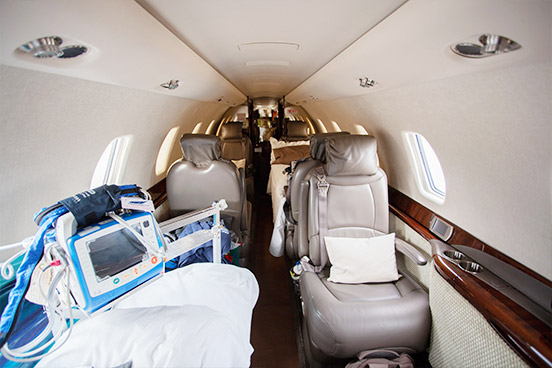
Medical flights from Austria: Air ambulance options for patients requiring intensive care
For patients who cannot travel commercially, a dedicated air ambulance is the most appropriate and clinically safest option.
An air ambulance is a specially configured aircraft, fixed-wing jet or turboprop, fitted with intensive care unit (ICU)-level equipment. This includes ventilators, cardiac monitors, infusion pumps, defibrillators, and all medications required to manage a critically ill or injured patient throughout the flight. The medical crew typically consists of a flight physician and a critical care nurse or paramedic, both trained in aeromedical transport.
From Austria, our air ambulances can depart from Vienna, Salzburg, Innsbruck, Graz, Linz, and Klagenfurt, as well as from smaller regional airfields depending on the patient's location and condition. The aircraft is configured around the patient's specific medical needs before departure.
Key benefits of our medical jets include:
Full ICU-level care throughout the flight with no interruptions.
Direct routing between origin and destination, minimising transit time.
Capacity to carry a family member or accompanying person alongside the patient.
Suitability for patients requiring oxygen, ventilation, cardiac support, or continuous sedation.
Flexibility on departure time, the flight operates on the patient's schedule, not a commercial timetable.
For the most acutely ill patients, such as those on ventilators, requiring haemodynamic support, or at risk of deterioration mid-flight, a private air ambulance is not simply the best option. It is the only safe option.
Medical escorts on commercial flights: Is this viable for emergency transfers?
A medical escort involves a trained medical professional, typically a nurse, paramedic, or physician, accompanying a patient on a scheduled commercial flight. This option is widely used for planned, non-emergency transport of patients who are medically stable but require professional supervision during travel.
For genuine emergency transfers, a commercial medical escort is rarely appropriate, for several reasons:
First, commercial airlines require passengers, including patients, to meet a minimum fitness-to-fly standard. Patients in acute distress, on continuous oxygen above permitted thresholds, or requiring equipment not permitted in a commercial cabin will not be cleared to board.
Second, commercial flights operate on fixed schedules. In an emergency, waiting for the next available seat on an appropriate route adds hours or days to the transfer timeline, which can be clinically unacceptable.
Third, the cabin environment of a commercial aircraft offers limited space, restricted equipment access, and no ability to adjust pressure or speed in response to the patient's condition.
Medical escorts remain an excellent solution for stable patients: those recovering post-hospitalisation, patients travelling for planned specialist consultations, or individuals who need monitoring but pose no immediate clinical risk. For these cases, the option is significantly more affordable than a dedicated aircraft and perfectly adequate from a medical standpoint.
If there is any doubt about whether a patient is stable enough for commercial travel, the medical team at MTI 24/7 will advise on the safest and most appropriate mode of transport before any decision is made.
Patient transport cost considerations: What shapes the price of an emergency transfer?
Medical transport costs vary depending on a range of clinical and logistical factors. MTI 24/7 does not publish fixed prices, because a quote built around the specific situation is always more accurate and fair than a generic estimate.
The variables that shape the cost of a patient transfer from or to Austria include:
Medical crew composition: the level of clinical care required determines crew size and specialisation.
Type of aircraft: turboprop, light jet, midsize jet, or long-range jet each have different operational profiles.
Ground ambulance coordination: bed-to-bed transport includes ambulance legs at both origin and destination.
Medical equipment on board: ICU-level configurations require higher-grade equipment and greater logistical preparation.
Distance and routing: a domestic transfer within Austria will differ significantly from a continental or intercontinental flight.
Every quote from MTI 24/7 is fully customised, transparent, and provided free of charge with no obligation. Families and hospitals can request a quote at any time of day or night and receive a detailed breakdown without any commitment.
Contact MTI 24/7 for a Customised Emergency Transfer Quote
MTI 24/7 is available around the clock across Austria and worldwide. Whether you need an emergency air ambulance or are planning a medically supervised transfer for a stable patient, our team will assess the situation, recommend the right transport option, and manage every step of the journey from the hospital bed to the destination. Contact us for a free, no-obligation quote.
Reach us by: