:quality(80) "header-bed-to-bed")
:quality(80) "Medical repatriation on a commercial flight")
Essential takeaways on medical repatriation by commercial flight:
Commercial flight repatriation is a safe, dignified, and cost-effective solution for medically stable patients who need to return home under qualified supervision, with either a seated medical escort or an installed airline stretcher.
Every mission requires airline medical clearance, approved equipment, and oxygen arrangements, all managed end-to-end by the MTI 24/7 coordination team.
MTI 24/7 delivers fully customised, bed-to-bed repatriations worldwide, 24/7, and always provides a free, non-binding quote tailored to each patient's clinical and logistical needs.
Falling ill or being injured far from home is one of the most disorienting experiences a person can face. Beyond the medical concern, there is the emotional weight of being away from loved ones, familiar doctors, and the comfort of home. Medical repatriation on a commercial flight offers a safe, dignified, and cost-effective way to bring patients back. At MTI 24/7, we coordinate every step of this journey, anywhere in the world, around the clock.
What is medical repatriation?
Medical repatriation is the organized transfer of a patient from a foreign country back to their home country, under appropriate medical supervision. It applies to travellers, expatriates, students, seafarers, and workers who fall ill, suffer an injury, or need to continue their recovery closer to home, family, and their own healthcare system.
Depending on the patient's clinical condition, repatriation can be carried out through:
A commercial flight with a medical escort (seated).
A commercial flight with a stretcher configuration.
An air ambulance (a dedicated, ICU-equipped aircraft).
The choice depends on several factors:
The distance and routing of the journey.
The medical equipment needed on board.
The infrastructure available at departure and arrival airports, such as runway capacity, handling services, and ground ambulance access.
The patient's clinical stability and level of care required, including whether they need to arrive intubated, on continuous monitoring, or simply mobile and stable.
When the patient's condition calls for a direct ICU-to-ICU transfer, an air ambulance is the natural choice. When the patient is stable, a commercial flight repatriation is often the most fitting and comfortable solution.
When can patients fly on commercial airlines instead of air ambulances?
Many patients can travel safely on a scheduled airline because modern commercial cabins, combined with a qualified medical escort, provide a controlled and monitored environment.
Cabin pressure is regulated, oxygen and approved medical devices can be carried on board, and airlines reserve priority boarding, extra space, and trained crew assistance for medical passengers. With a doctor, nurse, or paramedic supervising every stage, stable patients receive continuous care from departure to arrival.
Typical situations suited for commercial medical repatriation include:
Pregnant women with medical clearance to fly.
Post-stroke patients in stable neurological condition.
Oncology patients travelling between treatment cycles.
Post-operative patients discharged from intensive care.
Patients with reduced mobility unable to travel independently.
Elderly travelers requiring supervision, oxygen, or mobility support.
Stabilized chronic conditions such as COPD, diabetes, or renal disease.
Stable cardiac patients after a controlled event, with cardiology clearance.
Newborns and infants needing a pediatric escort after a hospital stay abroad.
Post-orthopedic recovery (fractures, hip or knee replacements, spinal surgery rehabilitation).
Patients needing emotional support, including those with severe anxiety, post-traumatic stress, or fear of flying after an incident abroad.
Mental health repatriations, such as patients recovering from a depressive episode, a manic phase that has been stabilized, an eating disorder, or substance-related hospitalization.
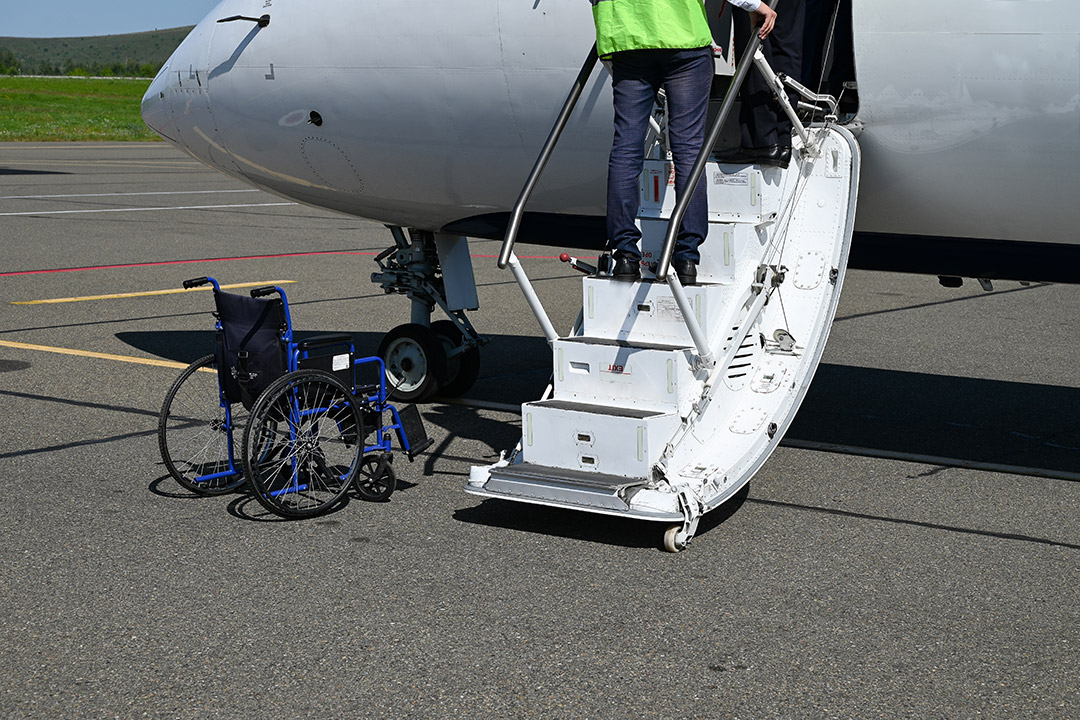
Medical Escort vs Airline Stretcher Service
At MTI 24/7, we offer two distinct commercial repatriation solutions, each designed to match the patient's clinical reality and personal comfort.
Medical escort on a seated commercial flight
A medical escort is a qualified doctor, intensive-care nurse, or paramedic who accompanies the patient throughout the entire journey, from the hospital bed or hotel room, into the ground ambulance or private transfer, through check-in, security, boarding, the flight itself, and finally to the receiving hospital, clinic, or family home.
Imagine being met by a calm professional in uniform, speaking fluent English, or, whenever possible, your own mother tongue, carrying a sealed medical kit and your complete file. From that moment, you are no longer navigating alone.
The patient travels in a standard cabin seat, frequently upgraded to Premium Economy, Business, or First Class for additional space, recline, and dignity. Seating is arranged with care:
Extra legroom is arranged for orthopedic patients or those requiring leg elevation.
Aisle seats are typically requested to allow easier movement, restroom access, and assistance.
The healthcare escort sits directly beside the patient for continuous observation and rapid intervention.
Bulkhead seats may be selected for patients with limited mobility, casts, or post-surgical positioning needs.
On long-haul flights, lie-flat business class seats are often preferred to reduce fatigue, support circulation, and lower the risk of deep vein thrombosis.
This option suits patients who can remain seated for the duration of the flight.
The air medical escort takes care of:
Oxygen therapy when prescribed.
Wheelchair assistance and discreet help with mobility.
Reassurance and human presence throughout a stressful journey.
Coordination with airline crew, ground staff, and ambulance teams.
Continuous monitoring of vital signs, oxygen saturation, and pain levels.
Medication administration on schedule, including injections and IV therapy when authorized.
Airline stretcher service
For patients who cannot sit upright for an extended period, an airline stretcher is installed directly inside the commercial cabin.
Picture a private, curtained-off area at the back of the economy class: a full medical stretcher is mounted over a block of seats, with bedding, oxygen, monitoring equipment, and your dedicated MTI 24/7 medical escort seated beside you.
The stretcher solution offers:
Privacy screening from other passengers.
Full lying-down position throughout the flight.
On-board oxygen and pre-approved medical devices.
Continuous in-flight medical supervision by the MTI 24/7 escort.
Pre-boarding before other passengers and priority disembarkation.
This service is well suited to patients recovering from major surgery, severe trauma, complex orthopedic injuries, or extended hospital stays who remain stable but cannot tolerate a seated position.
Good to know: Stretcher service is subject to airline approval and aircraft availability, and is typically requested several days in advance to secure the configuration on the chosen route.

Airline medical clearance requirements for repatriation
Every airline requires formal medical clearance before accepting a patient on board, to protect the passenger, the crew, and fellow travelers.
The standard documentation usually includes:
Approval for any in-flight oxygen, medication, or device.
Verification of the medical escort's qualifications and credentials.
A completed MEDIF form (Medical Information Form), signed by the treating physician.
A detailed medical report with diagnosis, current treatment, medication, and fitness-to-fly assessment.
Confirmation of clinical stability; most airlines require no acute event within the preceding 7 to 14 days.
Every airline has its own medical department, internal protocols, and approval timelines. MTI 24/7 prepares and submits the full clearance file, liaises directly with airline medical officers, and secures approval within the operational window.
How oxygen and medical equipment are arranged on commercial flights
In-flight medical needs require prior airline approval, without exception. Even devices the patient already uses at home cannot simply be brought on board. Each item must be reviewed, certified, and authorized by the airline's medical and safety departments well before departure.
This is because not all medical equipment is permitted in a commercial cabin. Restrictions exist due to cabin pressure variations, battery safety, electromagnetic interference with avionics, oxygen flammability rules, and the limited space available during an in-flight emergency.
Equipment generally allowed on board (with approval):
Nebulizers: battery-operated models, when prescribed.
Pulse oximeters and portable monitors: non-invasive and non-transmitting.
Manual blood pressure monitors and stethoscopes: standard medical escort tools.
Glucose monitors and insulin pens: small, non-pressurized, and essential for diabetic management.
Prescription medication, including controlled substances, when accompanied by proper documentation.
CPAP and BiPAP machines: accepted on most carriers for in-flight use, as they are low-power and self-contained.
Portable Oxygen Concentrators (POCs): battery-powered, because they produce oxygen on demand rather than storing it under pressure.
Equipment generally not allowed on board:
Large suction devices: bulky, power-hungry, and operationally impractical.
Any device with non-spillable wet-cell or unapproved lithium batteries: fire safety risk.
Defibrillators (AEDs) brought by passengers: only the aircraft's onboard AED is used, to avoid duplication and battery risks.
Mechanical ventilators requiring mains power: incompatible with cabin electrical systems and continuous high-power demand.
IV infusion pumps not certified for aviation: risk of electromagnetic interference and uncontrolled flow during pressure changes.
Compressed oxygen cylinders carried by the passenger: restricted because pressurized gas is a flight safety hazard; airline-supplied oxygen or approved POCs are used instead.
When a patient requires equipment that cannot be cleared for commercial use, MTI 24/7 advises switching to an air ambulance, where ICU-grade devices, ventilators, and full oxygen supplies are standard.
For commercial missions, our team verifies every battery's autonomy (covering the flight plus delays and layovers), arranges airline-supplied oxygen when needed, prepares customs documentation for medication, and confirms ground ambulance coordination at both ends.
Cost considerations of commercial medical repatriation
A commercial flight repatriation is often more economical than a private medical flight, simply because it shares the operational backbone of a scheduled airline: fuel, crew, aircraft, and route are already in place. The patient benefits from the airline's existing infrastructure, while MTI 24/7 layers a fully medicalized service on top.
By contrast, an air ambulance is a dedicated mission with its own aircraft, flight crew, and full ICU team. Both services are equally professional; they simply answer different clinical needs.
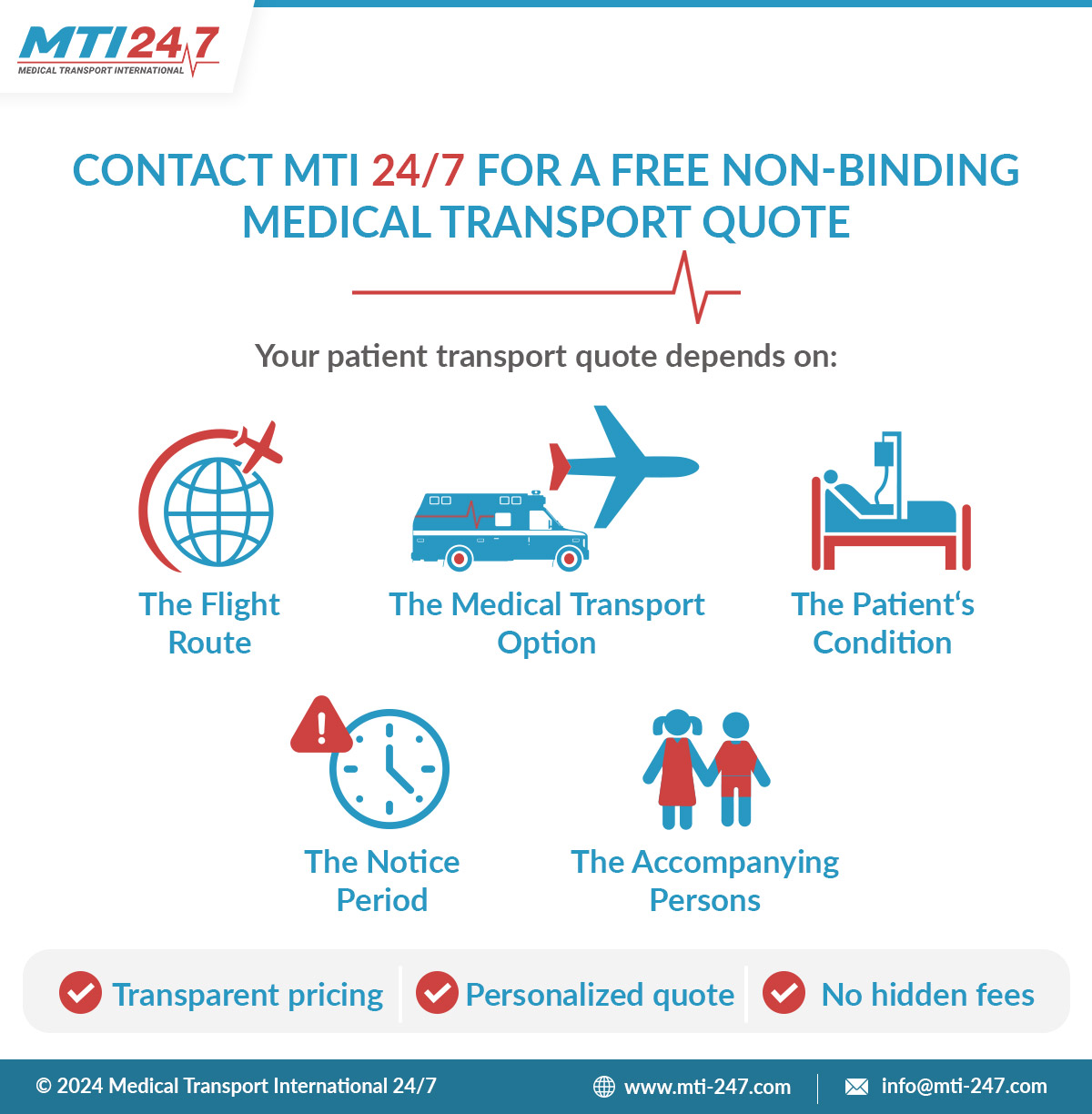
The cost of a commercial repatriation is influenced by:
Ground ambulance services at both ends.
Cabin class chosen for the patient and escort.
Service type: seated flight versus stretcher in-flight.
Distance, routing, and direct vs. connecting flights.
Medical equipment and oxygen required on board.
Airline-specific fees for stretcher installation, oxygen, or extra seats.
Number and seniority of medical escorts (single nurse, doctor–nurse team, pediatric specialist, psychiatric nurse).
Because every patient and every route is unique, MTI 24/7 never applies fixed pricing. Each mission is fully customized, and we always provide a free, non-binding quote; transparent, detailed, and adapted to your situation, with no obligation to proceed.
How MTI 24/7 coordinates your commercial medical repatriation
MTI 24/7 acts as a global medical transport coordinator, managing the full bed-to-bed journey:
Medical file review by our coordination physicians.
Recommendation of the most suitable transport solution.
Flight selection and booking with the best-suited carrier.
Airline medical clearance and complete documentation.
Medical escort assignment matched to the patient's clinical profile.
Equipment, oxygen, and medication logistics.
Ground ambulance coordination at departure and arrival.
Hospital-to-hospital communication for a seamless handover.
Real-time mission monitoring by our operations center.
Post-mission report for family, hospital, and insurer.
Our multilingual coordination center operates 24 hours a day, 7 days a week, supporting patients, families, hospitals, and insurance partners across every time zone.
Get back home through our medical repatriation services on commercial flights
With expert coordination, a commercial flight repatriation can be smooth, calm, and remarkably reassuring, even across long distances and multiple time zones. MTI 24/7 stands beside patients and families from the first medical assessment to the moment of arrival at the home hospital or family doorstep. Whatever the destination, whatever the time zone, our team is ready to listen, advise, and act. Contact us anytime for a free, non-binding quote and discover how a thoughtfully coordinated journey home is closer than you think.