:quality(75) "header-bed-to-bed")
:quality(75) "Organ Transplantation")
Air ambulance for organ transplants:
Organ transplant patients require specialized medical transport before, during, and after surgery due to critical illness, continuous monitoring needs, and compromised immune systems. MTI 24/7 offers air ambulance services for critically ill patients and commercial medical escorts for stable transplant recipients, ensuring appropriate care based on clinical status.
Turkey and other international destinations offer established organ transplant programs with shorter waiting times than Western countries. Selecting the right transplant center depends on donor availability, organ type, cost, distance, and post-transplant follow-up capability in your home country.
MTI 24/7 coordinates seamless bed-to-bed transport across international healthcare systems with 24/7 availability, multilingual support, and clinical expertise specifically trained in organ transplant logistics and patient care requirements.
Intro: Organ transplantation offers a second chance at life, but successful outcomes depend on reliable medical transport coordination. When donor organs become available, transplant patients must reach specialized centers without unnecessary delay across international borders. Whether you need an air ambulance for organ transplant transport, a medical escort on commercial flights, or end-to-end coordination of international logistics, selecting the right transport partner is essential. MTI 24/7 provides 24/7 bed-to-bed medical transport for transplant patients worldwide, ensuring safe, timely delivery to your transplant center with clinical precision and compassionate care.
Organ transplantation and organ donation explained
Organ transplantation is a surgical procedure replacing a non-functional organ with a healthy organ from another person. Organ donation is the voluntary act of giving one's organ to save another person's life, either after death or during life. Donors can be living individuals, typically family members, or deceased persons whose organs are recovered following brain death.
The relationship between donation and transplantation is foundational. More than 100,000 people worldwide wait for organ transplants, and in many developed countries, waiting times extend for years. This supply-demand gap has driven international medical tourism, with patients increasingly traveling to countries with shorter waiting lists or compatible donor availability.
Successful transplantation requires precise coordination and specialized medical transport. MTI 24/7 manages this complex logistics, ensuring transplant patients reach their centers safely and without unnecessary delay.
What are the top 3 organ transplants?
Kidneys, livers, and hearts represent the three most commonly transplanted organs globally. Each presents distinct medical and logistical considerations for patient transport.
1. Kidney transplant
Kidneys are the most frequently transplanted organs worldwide, accounting for approximately 80 percent of all solid organ transplants.
Chronic kidney disease affects millions globally, creating substantial demand. Kidney transplants can come from both living and deceased donors, and living donation has allowed many patients to avoid prolonged dialysis by receiving transplants from family members. Recovery from kidney transplantation typically requires 6-12 weeks before patients return to normal activities, though this varies based on individual factors and complications.
2. Liver transplant
Liver transplants represent the second most common procedure. The liver has remarkable regenerative capacity, which has enabled both living-related liver transplants, where a portion of a healthy liver is donated, and deceased donor transplants.
Patients require liver transplants due to end-stage liver disease caused by cirrhosis, hepatitis, or liver cancer. A critical consideration for medical transport is the organ's limited preservation time of 8-12 hours outside the body, making reliable air ambulance coordination essential. Recovery is more complex than kidney transplantation and often requires 12-16 weeks before returning to full function.
3. Heart transplant
Heart transplants are performed for patients with end-stage heart failure unresponsive to medical or mechanical support.
While fewer in number than kidney or liver transplants, heart transplants remain life-saving procedures. The heart can only be preserved outside the body for 4-6 hours, which creates urgent transport requirements and demands the highest level of coordination between procurement teams, transplant centers, and air ambulance services.
Organ transplants abroad: Turkey and international options
An increasing number of patients travel internationally for organ transplantation to avoid lengthy waiting lists, access established surgical expertise or pursue living donor options. Turkey has developed significant transplant capacity, with centers in Istanbul offering modern infrastructure, Joint Commission International accreditation, and transplant specialists trained at internationally recognized institutions.
Turkish transplant programs perform kidney, liver, heart, and pancreas transplants at costs significantly lower than North America or Northern Europe. Living-related transplants, where a donor family member contributes a portion of liver or kidney, eliminate dependence on deceased donor registries. Recovery timelines follow global medical standards: kidney transplant patients typically return to normal activities within 6-12 weeks, liver transplant patients within 12-16 weeks, and heart transplant patients within similar timeframes depending on post-operative complications.
Spain leads globally in organ donation rates with established kidney, liver, and heart programs. Germany, Canada, and the United Kingdom offer rigorous ethical oversight and strong outcomes across all organ types. For Asia-Pacific patients, Singapore and South Korea provide shorter wait times for kidney, liver, and heart transplants.
Selecting a transplant destination depends on donor availability, organ type needed, transplant center credentials, total cost, distance from home, legal requirements, and post-transplant follow-up in your home country. MTI 24/7 evaluates your options and arranges specialized medical transport, whether air ambulance or commercial medical escort, to your chosen transplant center worldwide.

Medical transport options for organ transplant patients: Air ambulance vs medical escort
Organ transplant patients require specialized medical transport before, during, and after surgery. Transplant recipients face unique challenges: critical illness at baseline, continuous medical monitoring needs, compromised immune systems, and strict timelines for reaching transplant centers. MTI 24/7 offers two primary transport solutions: air ambulance and commercial medical escort, each suited to different clinical scenarios and cost considerations.
1. Air ambulance for organ transplant patients
An air ambulance is a dedicated aircraft equipped with intensive care equipment and staffed by physicians, nurses, and paramedics trained in critical care. These aircraft function as flying ICUs, maintaining life support systems including ventilators, cardiac monitors, oxygen delivery, and comprehensive medications. The cabin pressurizes to sea level, reducing altitude stress and preventing gas expansion in surgical sites; critical for post-transplant patients.
MTI 24/7's air ambulances are configured specifically for organ transplant transport, with sterile environment protocols and immunosuppressed patient management.
When air ambulance is necessary
Air ambulance is appropriate for organ transplant patients who are critically ill, on mechanical support (ECMO, LVAD), or in ICU settings preventing commercial flight, as well as for:
Post-transplant patients developing serious complications such as sepsis, acute kidney injury, or organ rejection require air ambulance.
Patients with severely compromised immune systems benefit from controlled cabin environments that prevent infectious exposure.
Long-distance international transfers and patients transported within days of surgery require air ambulance's continuous monitoring and sterile conditions.
Benefits of air ambulance transport
Continuous monitoring occurs without interruption throughout the journey.
Sea-level pressurization prevents physiological complications that occur in commercial cabins.
Medical staff provide specialized transplant emergency care with immediate intervention capability.
Direct routing (where possible) eliminates airline scheduling delays; essential for organs with limited preservation windows.
2. Commercial medical escorts for organ transplant patients
A commercial medical escort is a physician, nurse practitioner, or registered nurse who accompanies patients on scheduled commercial flights, providing medical supervision and personal support. MTI 24/7's medical escorts conduct pre-flight readiness assessments, coordinate airline accommodations, monitor vital signs in-flight, carry portable medical equipment, and recognize transplant-specific complications.
When medical escort is appropriate
Medical escort suits stable organ transplant patients 2-4 weeks post-surgery with uncomplicated recovery, patients traveling for pre-transplant evaluation before surgery, and patients cleared for repatriation to their home country (typically 3-4 weeks post-transplant). Once infection risk decreases and patients tolerate activity and oral intake, commercial flight with medical escort allows faster return home.
Benefits of commercial medical escort
Commercial medical escort services significantly reduce transport costs while maintaining comprehensive medical oversight and safety standards.
Patients benefit from traveling on scheduled commercial flights with established routing and frequency, allowing flexible departure timing that accommodates medical readiness and family coordination.
MTI 24/7's multilingual escorts manage all logistics including special meals meeting post-transplant dietary needs, mobility assistance, airline coordination, and communication with medical facilities and family members across international borders.
This comprehensive support eliminates logistical stress for surgically weakened patients and ensures clear communication throughout the journey.
Choosing your transplant transport: Air ambulance or medical escort
Selection depends on medical stability, recovery stage, distance, organ type, and cost considerations. Critically ill pre-transplant and immediate post-transplant patients require air ambulance. Stable patients 3+ weeks post-transplant traveling for repatriation benefit from cost-effective medical escort. MTI 24/7 evaluates your clinical situation and recommends the appropriate solution for your organ transplant journey.
Coordinating transplant transport: How MTI 24/7 ensures safe patient delivery
Reliable organ transplant patient transport requires seamless coordination across international healthcare systems, airline networks, ground ambulance services, and medical teams. MTI 24/7's transplant coordination process delivers:
24/7 availability for urgent and planned transplant transport requests across all time zones.
Complete handoff documentation to your receiving transplant team upon arrival, ensuring continuity of care.
Real-time communication between patients, families, hospitals, and transplant centers throughout your journey.
Clinical expertise with physicians, transplant-certified nurses, and specialized paramedics matched to your medical complexity.
Direct coordination with your home hospital and receiving transplant center to obtain medical records and ensure aligned care protocols.
Continuous medical oversight throughout transport with monitoring for transplant-specific complications and immediate intervention capability.
Bed-to-bed transport from your current location through airport departure, in-flight care, airport arrival, and delivery to your receiving hospital.
Comprehensive assessments determining whether air ambulance or commercial medical escort is appropriate based on your medical status and clinical needs.
MTI 24/7 manages every detail of your organ transplant transport, allowing you and your family to focus on your health rather than logistics.
Organ transplantation requires reliable medical transport across international borders. MTI 24/7 specializes in air ambulance and commercial medical escort services for organ transplant patients worldwide, coordinating safe transport with clinical precision and 24/7 availability.
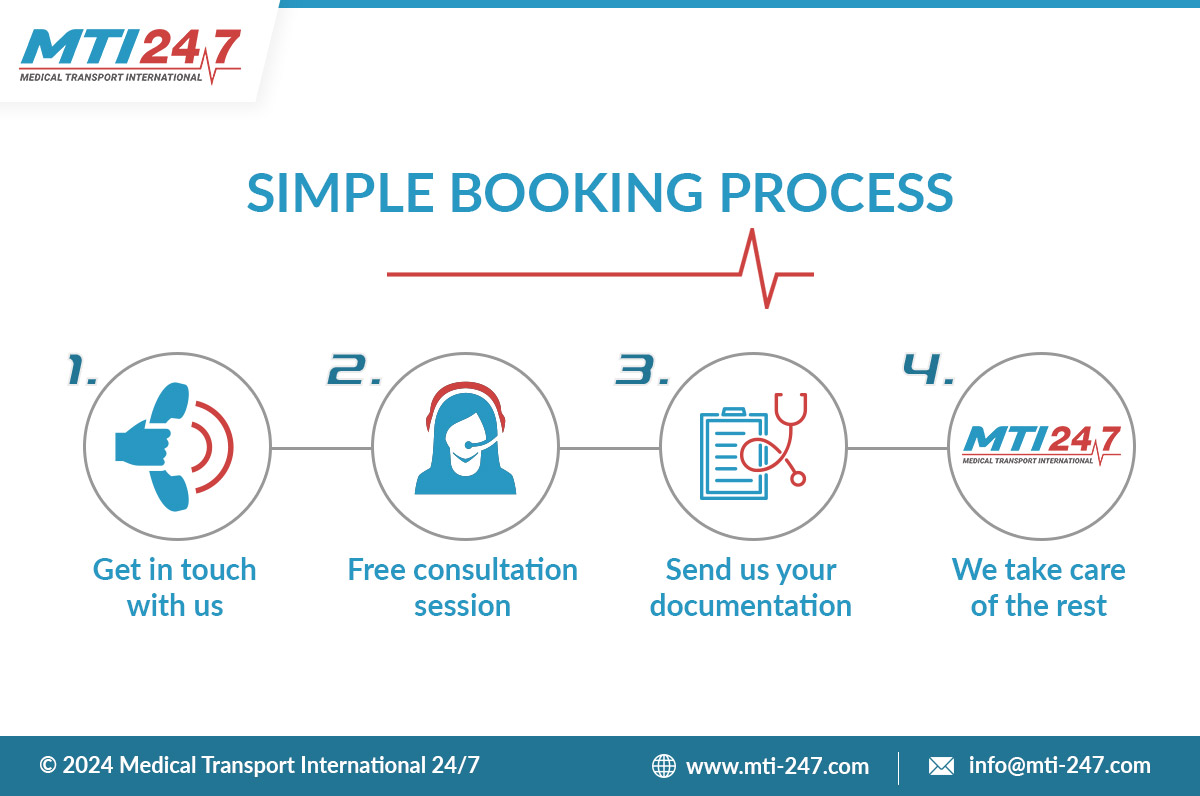
Contact us for a free quote
Whether you need critical care transport for pre-transplant patients, stable repatriation post-transplant, or complex international coordination, contact MTI 24/7 for a free consultation.
Reach out to our compassionate coordinators by:
Phone: USA: +16468635532 / UK: +442036080959
Email: info@mti-247.com
Our contact form