:quality(75) "header-bed-to-bed")
:quality(75) "philippines-siargao")
Why air ambulance services matter in the Philippines:
The Philippines' thousands of islands create medical emergencies that ground and maritime transport cannot solve. When ferry services shut down or roads become impassable, air ambulances provide the only reliable option for patients on remote islands needing advanced medical care.
Our air ambulances carry the same medical equipment found in hospital intensive care units, staffed by certified physicians, ICU nurses, and paramedics who provide continuous professional care from pickup to hospital delivery.
Whether your loved one requires a fully equipped air ambulance with an ICU team or can travel safely on a commercial flight with medical supervision, MTI 24/7 assesses your patient's medical needs and recommends the appropriate transport option.
Intro: Your loved one is critically ill. Time is running out. The nearest hospital with advanced care is hours away by road. For thousands of families across the Philippines' 7,600 islands, air ambulances are not a luxury; they are often the only option. Yet when you decide to call for help, one question hits: how much will this cost? At MTI 24/7, we have been there with families in your exact situation. That is why we are laying everything bare; no hidden fees, no confusion. Let us walk through exactly what air ambulance services cost in the Philippines.
Air ambulance services in the Philippines: Why they are essential
The Philippines has thousands of islands. This geography creates a medical emergency problem that ground transport simply cannot solve.
Why air ambulances are critical for island-based patients:
Distance and travel time barriers: Ground transport between islands requires ferry rides that can take 6-12 hours or longer. A patient with severe pneumonia, organ failure, or complications from chronic illness cannot wait that long. Air ambulances cover the same distance in 30-60 minutes. For non-emergency medical transfers, MTI 24/7 coordinates transport timing based on medical stability and weather conditions, sometimes requiring 24-48 hours for safe coordination.
Limited medical facilities on smaller islands: Most specialized care like cardiac units, trauma centers, and ICU capabilities exist only in major cities like Manila, Cebu, and Davao. Smaller islands have basic clinics, not hospitals equipped for critical cases.
Weather and sea conditions: During typhoon season, ferry services shut down completely. Air ambulances operate in conditions where maritime transport becomes impossible, making them the only viable option for patient transport.
Sustained stabilization during flight: Air ambulance services include onboard medical teams (nurses, paramedics, doctors) who provide ICU-level care during transport, not just a ride to the hospital. This continuity of care prevents patient deterioration during long transfers.
Relying on ferry schedules for medical transport in the Philippines creates dangerous delays. Our air ambulances eliminate this transportation gamble entirely.

ICU equipment on air ambulances in the Philippines: What is actually on board
Your critically ill family member needs more than transportation. They need a flying intensive care unit. Our air ambulances do not just move patients; we provide the same level of medical support found in hospital ICUs during flight.
What equipment MTI 24/7 includes on every air ambulance:
Mechanical ventilators: Our aircraft carry portable ventilators for patients requiring breathing support. Whether it is severe respiratory failure, pneumonia, or post-surgery complications, our ventilators maintain your loved one's airway safely throughout the flight.
Cardiac monitoring systems: Every MTI 24/7 flight includes continuous ECG monitoring that tracks heart rhythm in real-time. If your patient's heart becomes unstable, our onboard medical team detects changes and responds with appropriate care.
Defibrillators: We have defibrillation capability on every aircraft. If cardiac arrest occurs mid-flight, we can intervene without delay to restore normal heart rhythm.
Infusion pumps and multiple IV lines: Our air ambulances support simultaneous medication administration, blood transfusions, and fluid resuscitation through multiple IV access points. Critically ill patients often need 3-5 IV lines running at once, and we are equipped for exactly that.
Portable laboratory capabilities: Our blood gas analyzers provide real-time checks of oxygen saturation, electrolytes, and blood glucose during flight. These measurements guide treatment decisions and ensure your patient receives exactly the care they need in the air.
Suction equipment and airway management tools: For patients with compromised airways, MTI 24/7 carries suctioning devices, endotracheal tubes, and laryngoscopes to manage breathing passages professionally and safely.
Comprehensive critical care medications: Our air ambulances stock vasopressors for blood pressure support, sedatives, antibiotics, cardiac drugs, and pain management medications approved for in-flight use. Your patient has access to the same pharmaceutical resources available in hospital ICUs.
Redundant oxygen systems: MTI 24/7 carries multiple oxygen delivery methods and backup supplies to ensure continuous respiratory support throughout your flight with zero interruption.
Portable dialysis equipment: For patients with kidney failure requiring dialysis support, MTI 24/7 aircraft carry portable dialysis machines. We maintain your patient's dialysis schedule without delay, even during transport.
Neonatal and pediatric equipment: Our aircraft include specialized equipment for newborns and infants, including portable incubators, neonatal ventilators, and pediatric-sized airways and monitoring systems. MTI 24/7 transports the most vulnerable patients with the same expertise as major pediatric hospitals.
The equipment we carry is only valuable because our medical team knows precisely how to use it. MTI 24/7 staffs every flight with certified ICU nurses, paramedics trained in critical care transport, and board-certified physicians specializing in emergency or critical care medicine. Our medical crew undergoes training on all equipment and protocols. Your family member is not just transported; they are cared for by hospital-level professionals who have dedicated their careers to keeping critically ill patients stable during transport.
Domestic air ambulance flights between Philippines’ archipelago
Island-to-island medical emergencies in the Philippines create a unique problem: patients trapped on smaller islands with limited medical care, needing rapid access to advanced facilities on other islands. MTI 24/7 operates dedicated domestic air ambulance flights specifically designed for these inter-island medical emergencies.
What MTI 24/7's domestic air ambulance service provides:
Direct routes between major medical hubs: MTI 24/7 flies patients directly from smaller islands to Cebu, Davao, and Manila. No transfers. No waiting. Direct transport with continuous ICU care means your family member receives uninterrupted medical attention from dispatch to hospital arrival.
Coverage across all major Philippine island groups: Whether your emergency occurs in the Visayas, Mindanao, Luzon, or Bicol region, MTI 24/7 has aircraft positioned to reach you quickly. No island in the Philippines is too remote for our domestic network.
Weather monitoring and route flexibility: Our pilots and medical team continuously monitor typhoon forecasts and sea conditions. If the direct route becomes unsafe, MTI 24/7 adjusts the flight path to ensure your safety without delaying transport.
International air ambulance flights: Beyond domestic transport, we also operate international flights for patients requiring specialized care outside the Philippines. Our international network includes medical partnerships across Southeast Asia and beyond, allowing seamless transfers if your patient needs care which cannot be provided domestically.
Contact MTI 24/7 for domestic island flights as soon as a patient is identified as needing transfer. Our worldwide air ambulance network means we are often already closer than you think, reducing response time even further.

Air ambulance cost breakdown in the Philippines: Domestic vs international pricing
Pricing for our air ambulance services varies depending on where you are flying and what equipment you need. MTI 24/7's cost breakdown is transparent: no hidden fees, no surprise charges at landing.
What influences your air ambulance cost:
Aircraft type: MTI 24/7 operates helicopters for short inter-island routes and pressurized fixed-wing aircraft for longer distances. Each aircraft type is selected based on your specific route, distance, and medical requirements for optimal safety and care.
Distance: Every additional kilometer increases fuel consumption and flight time. A 200-kilometer flight requires different fuel and crew resources than a 400-kilometer flight when using the same aircraft type.
Medical complexity: A stable patient with a broken leg requires basic paramedic care during transport. A patient on a ventilator requiring continuous cardiac monitoring and medication adjustments requires a physician and specialized ICU nurse. Your medical team is matched to your patient's actual condition.
Specialized equipment needs: Patients requiring dialysis support, neonatal care, or continuous monitoring during flight receive all necessary specialized equipment included in your MTI 24/7 quote; no additional fees or surprises.
Bed-to-bed service: MTI 24/7 coordinates ground ambulance pickup at your origin location and delivery to your receiving hospital. Your patient travels seamlessly from their starting point to the final hospital bed without transfer gaps or delays.
We provide free, non-binding quotes that detail exactly what is included in your cost. This allows you to understand precisely what your family is paying for and make an informed decision with complete transparency.
Medical escort on commercial flights in the Philippines: When it is the right choice
Not every patient needs a dedicated air ambulance. Some stable patients can fly safely on commercial airlines with professional medical supervision. MTI 24/7 medical escort services provide continuous professional care during commercial flights, making them an excellent option for patients who medically qualify.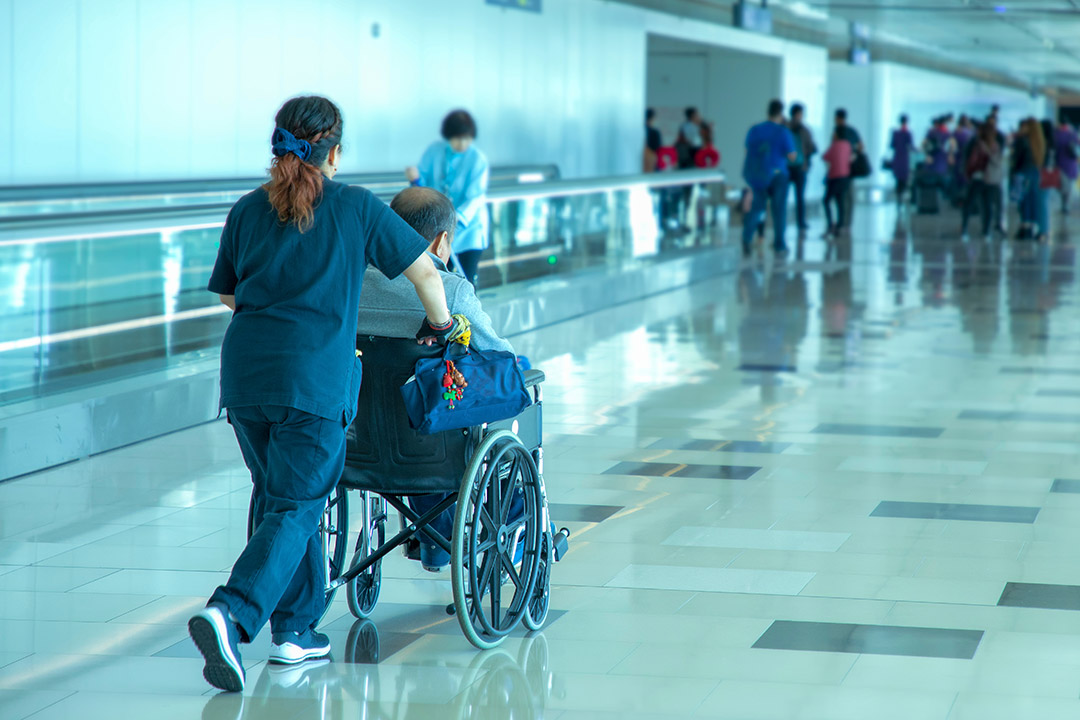
When MTI 24/7 recommends medical escort for your patient:
Patient is stable and conscious: If your family member can sit upright, communicate, and maintain their own airway without mechanical ventilation, they are a candidate for commercial flight with medical escort. Stability during flight is the determining factor.
Continuous ICU-level monitoring is not required: If your patient does not need moment-to-moment ventilator adjustments or complex medication infusions, our healthcare escorts provide the professional oversight your family needs.
Recovery phase transport: A patient three weeks post-surgery who is walking and eating does not need a dedicated air ambulance. MTI 24/7 medical escort provides safety and professional oversight while your family member completes their recovery journey.
MTI 24/7 medical escorts are either board-certified physicians or registered nurses with critical care experience. They carry airline-approved portable oxygen, emergency medications, cardiac monitoring equipment, and IV supplies throughout the flight. They sit with your patient continuously, monitor vital signs at regular intervals, manage pain or nausea, adjust medications as needed, and communicate with the flight crew.
Get in touch with MTI 24/7 for your free medical assessment!
Your family deserves clarity and confidence during a medical crisis. MTI 24/7 provides complimentary medical assessments to determine the safest, most appropriate transport option for your loved one. Contact us; our team is available 24/7 to answer your questions and guide you through every step.
Reach us by:
Phone: USA: +16468635532 / UK: +442036080959
Email: info@mti-247.com
Our contact form